
Kenya's regulator has cleared a route for local investors into Africa's largest share sale, and the Nairobi Securities Exchange wants it to become the template for how African savings reach African industry across borders
What to know
- Kenya’s Capital Markets Authority approved global depositary receipts on 5 October, letting Kenyan investors take part in the Dangote Petroleum Refinery’s offer in Lagos.
- The refinery is selling 4.1 billion new shares at ₦525 (about $0.40) each, worth ₦2.15 trillion (about $1.63 billion) if fully subscribed.
- NSE chief executive Frank Mwiti told Sable the exchange sees the deal as a model for connecting Africa’s national stock markets.
- The Dangote group targets 10 million retail investors in its offer. The NSE separately aims for 9 million active retail investors across its market by 2029.
- Dangote has confirmed his intention to list the planned East African refinery in Lamu on the NSE once it is completed.
Kenyan investors can now take part in the Dangote Petroleum Refinery’s initial public offering in Lagos. The Capital Markets Authority said on 5 October that it had approved a short form prospectus submitted by Renaissance Capital (Kenya) for global depositary receipts. The Nairobi Securities Exchange is positioning that structure as a working model for linking Africa’s national stock markets.
The refinery is offering 4.1 billion new shares on the Nigerian Exchange at ₦525 (about $0.40) each, a sale worth ₦2.15 trillion (about $1.63 billion) if fully subscribed, and the offer closes on 13 October. The authority said Renaissance Capital Kenya will hold funds collected from Kenyan investors under custodial arrangements, working with its affiliate licensed in Nigeria. After the offer closes and allocations are confirmed, it will structure the receipts for listing on the NSE, subject to approval from Nigeria’s Securities and Exchange Commission. The authority described the transaction as the first since Kenya issued its policy guidance on global depositary receipts and notes. It also named seven other licensed firms facilitating client participation through correspondent arrangements in Nigeria.
Frank Mwiti, the exchange’s chief executive, told Sable in a one-on-one interview that the NSE sees the deal as a demonstration of what it can do as an African capital-markets platform. He described it as more than the addition of one more security to the market. If a major African enterprise can reach investors in another African market through the right infrastructure and regulatory framework, he said, it creates a model other issuers and exchanges can replicate. “African exchanges should not view themselves only as national marketplaces,” Mwiti said. “We should increasingly think of ourselves as interconnected gateways through which African capital can support African businesses.”
Mwiti framed the transaction against what he sees as the central constraint on the continent’s markets. Africa holds significant pools of savings, major enterprises and increasingly sophisticated financial institutions, he said, but its markets have historically operated largely within national boundaries. In his view, the next phase of development has to be about connectivity, joining those pools of capital to businesses wherever they are located. The receipts let investors in Kenya reach an enterprise originating in Nigeria while still using the local market infrastructure they already know, which he called a practical example of how that connection can work.
He tied the case directly to industrial policy. “If we want to industrialise Africa, we need African capital to finance African industry,” Mwiti said. He added that Africans will only share in that growth if mechanisms exist for African investors to own and take part in African enterprises, and he described the Dangote receipts as one building block in that larger ambition.
Two targets, one market
The Dangote group has set its own target of bringing 10 million retail investors into the offer. The NSE’s goal is separate and broader: its 2025–2029 strategy aims for 9 million active retail investors across the whole market by 2029, independent of any single transaction. Mwiti described broad participation as one of the central pillars of that strategy, and said the Dangote offer gives the exchange a platform to accelerate it.
The exchange is looking beyond its existing investor base to Kenyans who have never bought listed shares, Mwiti said, naming young professionals, entrepreneurs, members of savings and credit cooperatives, savings groups and the diaspora. The effort is about removing barriers to participation, not simply opening more accounts, he said. It relies on technology, partnerships, investor education and simpler access channels, including the mobile investment platform Ziidi Trader, which the exchange has supported. Mwiti said the Dangote offer can show that capital markets are open to ordinary Africans who want a stake in the ownership and growth of major African enterprises, as well as to large institutions and sophisticated investors.
For the exchange itself, Mwiti expects a transaction of this scale to raise the profile of the Kenyan market, deepen engagement with investors and potentially broaden participation among institutions and retail investors alike. It should also show prospective issuers that a Nairobi listing can open access to a wider pool of African capital. He said the aim is a deeper, more diverse and more connected market, as opposed to a burst of activity around a single deal.
The Lamu question
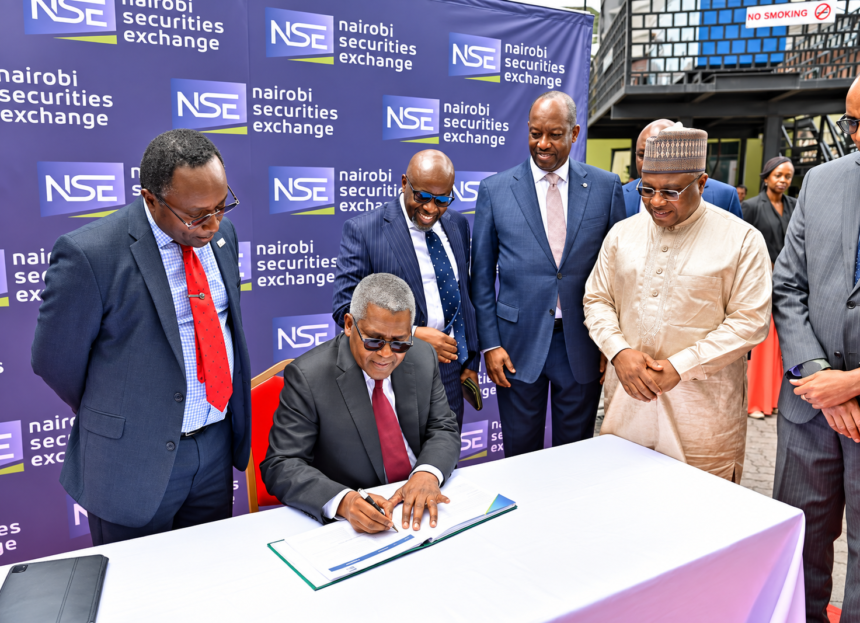
The exchange’s longer-term interest in the Dangote relationship centres on the group’s planned East African refinery in Lamu. Aliko Dangote broke ground on that project with President William Ruto on 30 September. Mwiti said Dangote confirmed at an investor engagement at the exchange his intention to list the refinery on the NSE once it is completed. The exchange will work with Dangote Industries Limited, its advisers and the relevant regulators to advance that listing as the project progresses.
Mwiti said a Nairobi listing would let Kenyans and investors across the region own a stake in a major industrial asset in East Africa. It would also deepen local ownership of strategic productive assets, mobilise domestic and regional capital, and strengthen the link between the region’s industrialisation agenda and its capital markets. He did not say whether formal talks have begun. The Capital Markets Authority has drawn a clear line between the two projects, saying the current offer relates only to the Nigerian refinery and is not an offer of shares in the Lamu project.
What’s next
- 13 October: the Dangote refinery offer closes.
- After allocation: Renaissance Capital Kenya structures the depositary receipts backed by the shares allocated to Kenyan investors.
- Nigerian approval: the receipts can list in Nairobi only after Nigeria’s Securities and Exchange Commission approves.
- November: the refinery’s shares are expected to begin trading on the Nigerian Exchange.
- Lamu: the NSE will work with Dangote Industries Limited, its advisers and regulators toward a listing once the refinery is completed.