

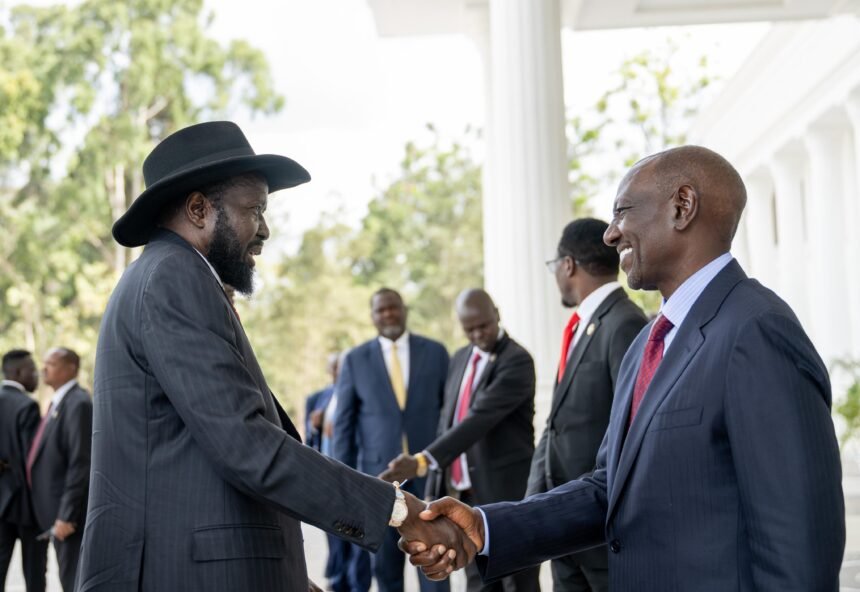
South Sudan President Salva Kiir Mayardit held talks with Kenyan President William Ruto at State House, Nairobi, on Monday, October 5, with Juba’s December 22 general election and the planned Dangote refinery in Lamu among the issues on the table.
The two leaders “expressed satisfaction with the strong relations between our two nations and resolved to continue opening more opportunities for trade and investment for our citizens,” Ruto said in a statement on his official X account.
He also thanked Kiir for South Sudan’s participation in the groundbreaking of the Dangote East Africa Refinery in Lamu County the previous week.
Neither government announced a signed agreement after the talks.
The trip is Kiir’s first foreign visit since he dissolved South Sudan’s transitional unity government on September 22 and set up a caretaker administration, his office said. He flew out of Juba on Sunday, October 4, seen off by Caretaker Minister for Presidential Affairs Africano Mande Gedima, and was received at Jomo Kenyatta International Airport by Kenya’s Public Service Cabinet Secretary Geoffrey Kiringa Ruku.
The election
Ruto pledged Kenya’s support for the December vote, which would be South Sudan’s first general election since independence in 2011. “Kenya stands ready to support South Sudan in this endeavour while encouraging dialogue and consensus among all parties,” he said.
Kiir told Ruto that South Sudan had completed the legal steps required for the elections and that logistical and financial preparations were under way, according to the South Sudanese presidency. Kiir’s office said Ruto welcomed the dialogue and encouraged South Sudanese parties to keep negotiating.
Presidential Press Secretary Arek Ajou Deng said before the meeting that the talks would cover bilateral relations, election preparations and efforts to secure regional and continental support for a peaceful and credible vote. Ajou’s statement confirming the trip followed social media reports about the president’s health; it did not address his health.
Kenya has been involved in South Sudan’s peace process before. Nairobi hosted the Tumaini Initiative, launched in 2024 to bring groups that had not signed the 2018 peace agreement into negotiations with Juba.
The refinery
Ruto broke ground on the Dangote East Africa Refinery in Lamu on September 30, alongside Ugandan President Yoweri Museveni and Ethiopian Prime Minister Abiy Ahmed. The plant is designed to process 700,000 barrels of crude a day, according to Dangote Group chairman Aliko Dangote, who has put its cost at about $16 billion. Kenyan officials have valued the project at about Ksh.2.2 trillion ($17 billion).
The refinery is being planned to draw crude from several countries. Ruto has said Kenyan oil from Turkana’s South Lokichar Basin will form part of the supply, with commercial production there expected to begin in December 2026, and that Dangote has agreed to help Kenya build a pipeline linking Turkana to Lamu. He has also said talks are under way with neighbouring producers on additional crude.
South Sudan features in Kenya’s supply projections. David Ndii, Ruto’s economic adviser, has estimated that East Africa could supply the refinery with more than 600,000 barrels a day, including about 350,000 barrels from South Sudan, 250,000 from Uganda and 120,000 from Kenya. Neither government said after Monday’s meeting that a supply arrangement had been discussed or agreed.
South Sudan’s oil
South Sudan produced about 174,000 barrels of crude a day as of June, according to Ministry of Petroleum Undersecretary Santino Ayuel Longar. Ndii’s estimate of 350,000 barrels a day from South Sudan is about twice that level. Output exceeded 300,000 barrels a day shortly after independence in 2011, before conflict, insecurity and ageing infrastructure cut production, petroleum officials have said.
The recovery follows a year in which most of the country’s exports stopped. The war in Sudan forced the closure of the Dar Blend pipeline, which carries most of South Sudan’s crude to Port Sudan on the Red Sea, from February 2024 into 2025, according to the World Bank.
The International Monetary Fund (IMF) said in 2024 that oil exports had fallen to about one third of their previous level. Production resumed after Sudan lifted force majeure on January 4, 2025, the Ministry of Petroleum said at the time.
The World Bank estimates that daily production rose towards 157,000 barrels in the first half of fiscal 2026, from around 95,000 in fiscal 2025.
In December 2025, Sudan’s warring parties and South Sudan reached a tripartite security agreement to protect oil export infrastructure inside Sudan, the bank said.