
Nigeria’s Dangote Group is exploring investments worth between $10 billion and $15 billion in Egypt, as its founder, Aliko Dangote, seeks to expand the conglomerate’s industrial footprint in North Africa and strengthen economic ties between two of the continent’s largest economies.
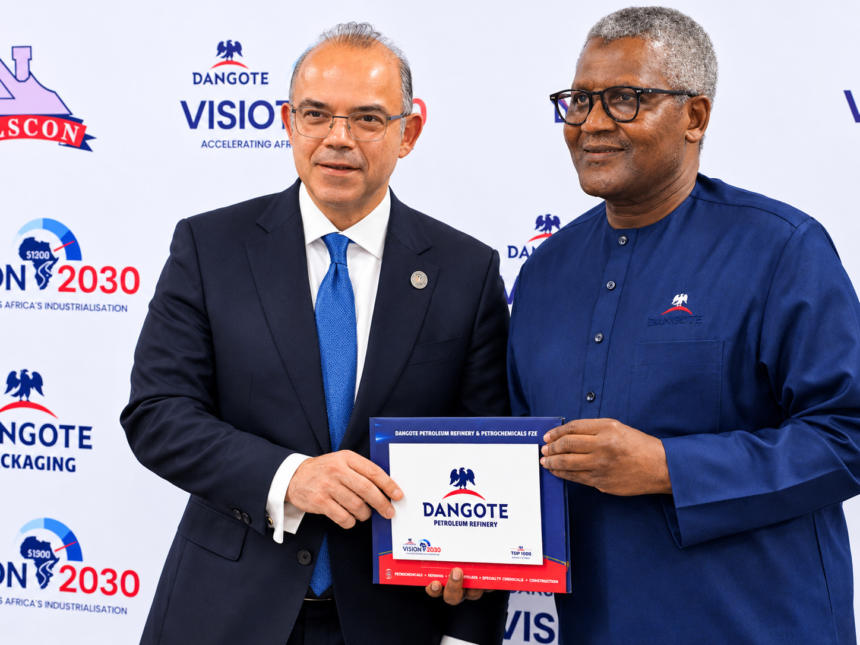
The proposed investment follows a November 1, 2026, meeting in Lagos between Dangote and Egypt’s Minister of Investment and Foreign Trade, Mohamed Farid Saleh, who led a delegation of senior government and industry officials.
The discussions focused on identifying investment opportunities as the Nigerian conglomerate advances its Vision 2030 strategy, which seeks to build large-scale manufacturing and industrial operations across Africa.
Oil refining and petrochemicals are expected to form the backbone of the proposed Egyptian investment. Dangote has previously indicated that the initial commitment could reach $10 billion, with the overall investment potentially exceeding $15 billion depending on discussions with Egyptian authorities.
The billionaire wants to position Egypt as a major exporter of refined petroleum products, reducing its dependence on imported fuel while building additional industrial capacity.
Egypt has welcomed the prospect of a long-term partnership with the Nigerian group. During an earlier investment engagement in Cairo on October 15, officials from the country’s General Authority for Investment and Free Zones expressed interest in deepening cooperation with major African conglomerates and translating investment discussions into actual projects.
Dangote’s $100 Billion Vision
The Egyptian expansion is part of a strategy by Dangote to transform his business empire into a $100 billion annual revenue group by 2030.
The businessman has pledged to invest as much as $50 billion in industrial projects across Africa over the same period, with financing expected to come from internal cash generation, equity and debt.
His investment pipeline includes a proposed 530-kilometre subsea gas pipeline, electricity generation capacity of up to 10,000 megawatts, and a linear alkylbenzene manufacturing plant with an annual capacity of 400,000 metric tonnes.
The group is also looking to expand urea fertiliser and polyethylene production while increasing Dangote Cement’s annual production capacity to 100 million tonnes.
These investments span energy, petrochemicals, agriculture and construction materials, reflecting the group’s ambition to build an integrated industrial business with operations across multiple African markets.
What Egypt Stands to Gain
For Egypt, a potential investment of this scale could bring additional capital into its energy and manufacturing sectors, strengthen domestic production and create opportunities for exports into regional markets.
It would also deepen Egypt’s engagement with African private-sector investors at a time when governments across the continent are seeking to attract investment into industries that can reduce import dependence and create jobs.
The proposed investment is yet to be finalised, and the specific projects, financing arrangements and implementation timelines remain under discussion.
However, the talks signal growing interest among Africa’s largest industrial players in building businesses across national borders rather than concentrating investments within their home markets.