

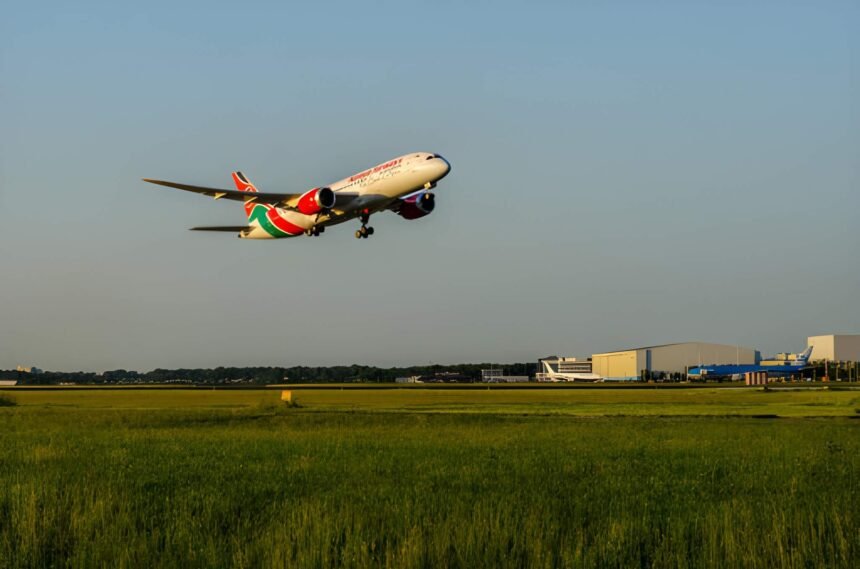
Kenya Airways (KQ) has issued another profit warning, projecting that its 2026 earnings will fall by at least 25% compared with the previous financial year, as rising fuel prices and aircraft shortages continue to weigh on its operations.
In a notice dated November 26, 2026, the airline’s Board of Directors attributed the expected decline to escalating aviation fuel costs linked to the Middle East conflict, global supply chain disruptions and shortages of critical aircraft spare parts.
The airline said prolonged delivery timelines for aircraft components had disrupted fleet availability and operational reliability, increasing costs and putting pressure on profit margins.
The latest announcement marks the third publicly reported profit warning by Kenya Airways in five years. The first came in January 2023, when the airline warned that its 2022 earnings would be at least 25% lower than those of 2021, largely due to foreign exchange losses arising from its financial restructuring. It issued another warning in November 2025, projecting earnings at least 25% below its 2024 performance. The latest warning covers the 2026 financial year.
Losses deepen despite revenue growth
The warning comes after a difficult financial year in 2025, when KQ swung back to a net loss of KSh17.16 billion, reversing a KSh5.43 billion profit recorded in 2024.
Revenue declined by 14% from KSh188.5 billion to KSh161.47 billion, while the airline recorded an operating loss of KSh5.61 billion against an operating profit of KSh16.62 billion in the previous year.
The financial pressure continued into the first half of 2026. KQ reported a net loss of KSh16.08 billion for the six months to June, 32% higher than the KSh12.15 billion loss recorded in the corresponding period of 2025.
Revenue, however, grew by 9% to KSh81.25 billion, supported by passenger and cargo demand. The gains were offset by a 14% increase in operating costs to KSh91.9 billion, while fuel expenses rose by 32%.
Aircraft availability remains a challenge
KQ’s financial difficulties have been compounded by aircraft maintenance and spare-parts shortages that have left some of its planes grounded.
The airline added a Boeing 737-800 passenger aircraft to its fleet in February 2025 through an arrangement with Dubai Aerospace Enterprise (DAE), increasing its capacity to 35 aircraft at the time.
However, its more recent fleet developments have largely involved returning grounded aircraft to service rather than acquiring new planes. In July 2026, a Boeing 787-8 Dreamliner resumed operations, while a Boeing 777-300ER was also redelivered to the airline.
The airline has also accessed additional Boeing 747 freighter capacity through a capacity-purchase arrangement to strengthen its cargo business.