

Kenya’s meat industry is worth close to 400 billion shillings a year, and just under five percent of that value crosses a border. Exports came to 145.4 million dollars in 2024, small next to domestic consumption but growing at close to twenty-three percent a year, and that growth rate is now the number driving government policy.
- A market that is tightening, and a market that is not
- What Kenya is actually shipping, and to whom
- Looking past the Gulf, toward buyers Kenya has never sold to
- The infrastructure quietly deciding whether any of this works
- Why the meat on the plane is not the meat in the market
- The twenty percent question
Contents
- A market that is tightening, and a market that is not
- What Kenya is actually shipping, and to whom
- Looking past the Gulf, toward buyers Kenya has never sold to
- The infrastructure quietly deciding whether any of this works
- Why the meat on the plane is not the meat in the market
- The twenty percent question
A goat slaughtered in a Kenyan county on a Tuesday morning can be on a plate in Dubai by Wednesday night. That twenty-four-to-forty-eight-hour window, from pasture to airfreight to Gulf dinner table, is the commercial logic Kenya is now building its livestock strategy around.
The window is short and expensive to hold open. But bulk exporters an ocean away cannot buy their way into it, and Kenya has spent the past two years betting that freshness, certification, and an indigenous breed most of the world has never heard of are worth more per kilogram than anything a container ship can deliver.
The breed doing the heavy lifting is the Boran, developed over generations for the Arid and Semi-Arid Lands that cover roughly eighty percent of Kenyan territory. The Boran survives drought, resists the ticks and parasites that decimate other cattle, and puts on weight fast on open pasture alone. Pasture-raised, lower in fat than grain-finished competitors, and cheap to raise because it needs almost no purchased feed or chemical intervention, the Boran is being repackaged for Gulf buyers around scarcity, terrain, and provenance.
Kenya cannot win on price, so the story matters. Brazil exported 4 million tonnes of beef in 2026 on USDA-FAS forecasts, roughly fourteen percent of global market share, and controls between thirty and fifty percent of the Gulf import market Kenya is now chasing. Brazilian beef supplies close to 41 per cent of Kenya’s own domestic meat imports. Kenya has read that scoreboard and stopped competing on it.
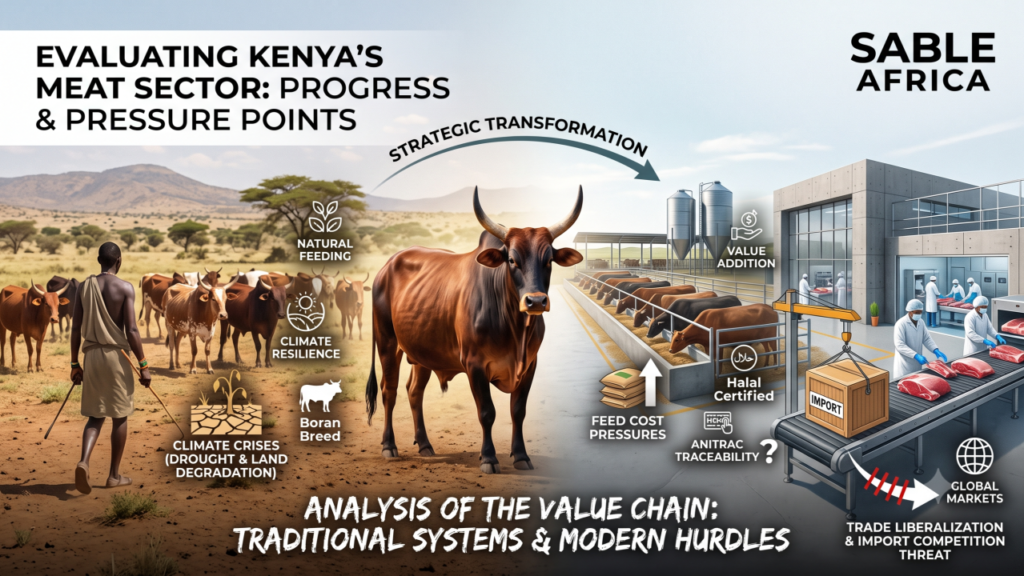
The pivot toward Boran, toward Halal certification, toward premium airfreighted cuts, concedes the volume game to South America and bets everything on the story instead.
A market that is tightening, and a market that is not
The timing is mixed. Global bovine meat trade is projected to contract slightly in 2026, down about zero point six per cent to 13.8 million tonnes, as China introduces new import quotas and exportable supplies tighten worldwide. Tighter supply has kept prices firm globally, and FAO’s own market reporting notes that recent supply disruptions have begun diverting import volume toward African markets, a shift that favours Kenya if its cold chain and certification systems can absorb the demand fast enough.
The real opportunity is halal, not beef in general. The global halal meat market was valued at roughly 1.08 to 1.09 trillion dollars in 2025, on a trajectory that industry forecasters put well past a trillion and a half within the decade, with the Middle East and Africa region expected to grow at a healthy clip through 2030 as Gulf governments treat halal food infrastructure as state investment.
Saudi Arabia’s multi-billion-dollar livestock city under Vision 2030 and Dubai’s build-out of what is billed as the world’s largest foodstuffs logistics hub are the buyers Kenya is trying to sell the Boran to, and both are spending as though certified premium meat is now a permanent feature of Gulf food security.
What Kenya is actually shipping, and to whom
Strip away the strategy and look at what left the country in 2024: 613,600 tonnes of meat produced in total, up ten point two per cent on the year before, worth close to 397.5 billion shillings. Beef alone accounted for 260,083 tonnes and 159.7 billion shillings of that. Domestic consumption swallows more than ninety-five per cent of production by value, and total exports came to just 145.4 million dollars. The goat, not the marketed Boran beef, is currently carrying Kenya’s export ambitions.
Sheep and goat meat made up 130.4 million dollars of that export total, close to ninety per cent of everything Kenya sold abroad, almost entirely into the Gulf.
The UAE took the largest share by far, 83.3 million dollars, close to 57 per cent of total export value, followed by Bahrain at 16.9 million, Kuwait at 16.8 million, and Saudi Arabia at 10 million. The UAE alone paid roughly 5.47 billion shillings for Kenyan goat meat in just the first half of 2025, and the export segment as a whole is compounding at close to 23 per cent a year, comfortably outrunning the low single-digit growth rates USDA and FAO are forecasting for global beef trade over the same period.
Looking past the Gulf, toward buyers Kenya has never sold to
Kenya is looking beyond the Gulf. A 430 million dollar agricultural investment deal signed with China in 2025, built initially around frozen avocado, has become the opening for separate negotiations to bring meat into the relationship.
Indonesia is being courted specifically because Kenya’s halal certification credibility travels well, a route planners hope becomes an entry point into Southeast Asia rather than a single transaction.
Malaysia sits on the same target list, pursued through the Meat and Livestock Exporters Industry Council of Kenya as a second Halal-compliant foothold in the region. None of the three has produced meaningful volume yet.
All three share the same bet: certification, not price, opens premium Asian demand.
The infrastructure quietly deciding whether any of this works
Every buyer in this story, Gulf or Asian, now asks the same question before signing anything: Can you prove where this animal came from? Kenya’s answer is digital.
Kenya’s traceability push rests on the Animal Traceability and Registration System, ANITRAC, developed by a technology partner at Dedan Kimathi University of Technology. It builds a verifiable digital history for each animal, health records, vaccination status, origin, which is increasingly what Sanitary and Phytosanitary compliance abroad demands as a condition of entry rather than a formality.
Nyeri County has already committed resources to fold ANITRAC into its slaughterhouse upgrades, and private operators such as the Bachuma Livestock Quarantine Station now keep these records digitally instead of on paper.
Alongside the Livestock Identification and Traceability System, which tracks dipping and disease control, ANITRAC is what turns Kenya’s export pitch from a marketing claim into something a Gulf or Asian buyer can actually verify.
Behind the traceability systems sits a bigger infrastructure bet. The Kenya Investment Authority has secured 54 billion shillings to build 450 county feedlots, a network expected to add 108,500 tonnes of red meat to national output annually once complete. Feedlots standardise animals to the weight and consistency export buyers demand, and they give herds somewhere to survive the droughts that have historically wiped out pastoralist stock overnight.
The legislation meant to lock this in has had a slower path than the infrastructure itself.
The original Livestock Bill, 2024, was withdrawn by the National Assembly in August 2024 for fuller public participation after pushback from small-scale farmers, and returned this year as the Livestock Bill, 2026, gazetted in April.
The traceability mandate has since been split into its own legislation, the Draft Animal Identification and Traceability Bill, 2026, which cleared a National Validation Meeting on July 15, 2026, and is still moving through Parliament but has not yet come into force.
And then there is the number that undercuts every other number in this story. Kenya has close to a thousand slaughterhouses. Seven meet export-grade standards. Every trade deal, every certification drive, every feedlot going up in every county runs, eventually, through a bottleneck this narrow. Closing that gap will determine Kenya’s export ceiling over the next five years more than any single market-access negotiation.
The Farmers This Strategy Still Needs
Small-scale farmers still produce 80 per cent of the beef Kenyans themselves eat, and the same liberalisation opening Gulf and Asian doors is simultaneously opening Kenya’s own market to cheaper imports from elsewhere.
Negotiations under the U.S.-Kenya Strategic Trade and Investment Partnership have raised genuine alarm about local markets being undercut, and poultry farmers specifically face an estimated 172 billion shillings hit if the U.S. is granted full market access.
Ugandan poultry entering the East African Community below local production cost has already pushed more than 540,000 Kenyan farmers to cut output in recent years, and domestic producers carry a 20 to 30 per cent cost disadvantage against subsidised foreign competition even before that regional pressure is added on.
Cooperatives are the counterweight being built. Linking smallholders into the new feedlot network is meant to turn scattered pastoralist herds into commercial-scale, bargaining-capable suppliers, so that export premiums flow back past the broker layer that currently pays a pastoralist as little as 3,500 shillings for a goat that clears a far higher price once it is certified for export. South Africa’s experience with anti-dumping duties and quotas is the reference case Kenyan policymakers cite most often for the safeguard regime they still need to build alongside that cooperative push.
Why the meat on the plane is not the meat in the market
Freshness is the edge, but freight is expensive, and that tension is reshaping what Kenya actually sends abroad. The sector has been moving away from whole carcasses toward premium cuts, sirloin, rump, aged beef, priced between 1,200 and 4,000 shillings per kilogram, because only cuts at that price point can absorb the cost of flying meat to the Gulf inside the window that justifies the premium. An estimated 4.8 million dollars in cold chain investment is still needed to stabilise the routes between rural production zones and export-ready processing. Until that gap closes, wastage keeps eating into farmgate margins on both ends of the supply chain.
The twenty percent question
Kenya’s livestock sector currently contributes somewhere between two and three percent of GDP from meat alone. The government’s stated target for the sector as a whole is twenty percent, a bet that the Boran story, the traceability systems, the feedlot rollout, and the slaughterhouse upgrades all land roughly on schedule, against a global beef trade that is contracting even as halal demand expands beneath it.
Whether Kenya can turn seven export-grade slaughterhouses into enough of them fast enough to catch the Gulf and Asian demand now building will decide how much of that twenty percent is a forecast, and how much is a hope.