

Addis Ababa has spent the past two years running two separate reforms. One threw open Ethiopia’s banking sector to foreign capital for the first time in half a century, capping any single foreign investor at 40 per cent.
The other stood up a stock exchange from scratch, moving several of the country’s oldest private lenders onto public trading.
Neither reform was designed with the other in mind. But together they’ve split Ethiopia’s biggest private banks into two distinct categories, and which category KCB Group’s undisclosed target falls into determines almost everything about the deal it’s actually trying to do.
That distinction, more than the ownership cap itself, is the part of this story that hasn’t been told clearly yet.
KCB Group has been positioning for Ethiopia since at least 2015, when it opened a representative office and waited. When parliament finally passed legislation in December 2024 allowing foreign banks to operate, KCB moved quickly.
By mid-2025, its public stance was cautious: a stake of up to 40 percent in an Ethiopian lender, aligning with the new law’s cap on any single foreign investor. Seven months later, the tone had shifted.
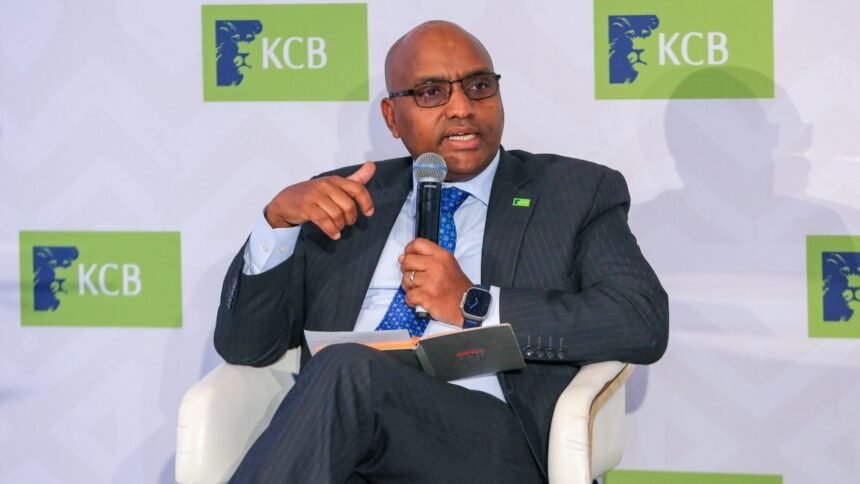
Finance Director Lawrence Kimathi told reporters the bank had finished shortlisting and identified a target and that control, not just a minority stake, was now the objective.
The ownership rules apply identically no matter which bank KCB picks.
A single foreign strategic investor can hold no more than 40 per cent of an Ethiopian bank. All foreign holders combined cannot exceed 49 per cent. Standalone foreign companies are capped at 10 per cent; individual foreigners at 7 per cent.
The law includes an exception letting the National Bank of Ethiopia approve higher stakes if an investment is deemed sufficiently strategic or if a bank is in distress. That clause has not yet been used. This part of the story is the same regardless of the target. What changes entirely, depending on which of the six realistic candidates KCB has actually chosen, is how that legal fight gets fought and what it costs to find out.
The Short List Nobody’s Published, and the Line Running Through It
- Awash Bank: Ethiopia’s largest private bank. Total assets of 442.6 billion birr and total equity of 58.4 billion birr for the year ended June 2025, per the bank’s own audited annual report. Listed on the Ethiopian Securities Exchange since April 2026, trading between roughly 2,800 and 3,000 birr against a book value of about 2,090 birr a share. More than 11,500 shareholders as of June 2025. Listed.
- Bank of Abyssinia: the second-largest of the group. Total assets of 286.2 billion birr and total equity of 28.8 billion birr for the same period, per its own ECMA-filed prospectus. Completed a rights offer in January 2026, pricing new shares at 1,600 birr, then listed on the exchange on July 28, 2026. Listed.
- Dashen Bank: total assets of 254.5 billion birr and total equity of 28.7 billion birr as of June 2025, per its own audited annual report. Widely seen as the most digitally advanced of the group. Has filed a prospectus and completed securities registration but remains unlisted, sitting in that holding pattern for more than six months. Registered, not yet trading.
- Cooperative Bank of Oromia: total assets of 197.4 billion birr and total deposits of 175.2 billion birr for the fiscal year ended September 2025, per the bank’s own release. Owned by cooperative unions and agricultural societies rather than conventional shareholders. Not part of the exchange process. Unlisted and structurally unusual.
- Hibret Bank: total assets of 113.93 billion birr and deposits of 92.68 billion birr for the year ended June 2025, per the bank’s disclosures reported by Addis Fortune. Pre-tax profit fell sharply to 749 million birr. Not visible in the exchange’s pipeline. Unlisted.
- Nib International Bank: total assets of 75 billion birr and deposits of 59 billion birr for the year ended June 2026, per the bank’s disclosures reported by Addis Fortune. Recovering from a 2.9 billion birr loss tied to Ethiopia’s currency reform. Also absent from the pipeline. Unlisted.
Two of the six are already trading. Four are not, though one of those four, Dashen, is mid-process and will not stay private-in-practice much longer.
If KCB’s target is Awash or Bank of Abyssinia
This is the harder and more expensive version of the deal, and it’s the one worth spelling out precisely. KCB cannot walk into a room with a handful of founding shareholders and negotiate a price nobody else sees. The shares already trade on a public exchange, so any serious buying activity would itself move the price and signal intent before a deal is done.
Assembling anything close to a 40 per cent block would most likely require a formal, disclosed tender process rather than a private agreement. And the price KCB would pay is not up for negotiation in the way book value is: Awash’s stock has traded near three times its own audited book value since listing.
Buying into a listed bank means paying whatever the market has already decided the bank is worth, in public, with every other market participant watching the same numbers. On top of all that, the 40 per cent cap still applies in full. Nothing about being listed makes the National Bank of Ethiopia any more or less likely to grant the control exemption. Listing only removes the option of doing this quietly and cheaply. It does not touch the legal ceiling at all.
If KCB’s target is Dashen, Hibret, Nib, or Coopbank
This is the version of the deal nobody is really talking about, and it looks completely different.
For any of these four, KCB retains exactly the path it would have had five years ago: a private conversation with a concentrated group of shareholders, a negotiated price with no public market forcing transparency, and no tender-offer mechanics to navigate.
Bank of Abyssinia’s own January 2026 rights offer, priced at a discount to its book value to keep existing shareholders happy, is a useful proxy for what an unlisted, privately negotiated Ethiopian bank price can look like before a public market gets involved and pushes it upward.
If KCB is negotiating with Dashen, Hibret, Nib, or Coopbank right now, it is very plausibly negotiating at something closer to that kind of quiet, book-anchored price, not the exchange-inflated one Awash commands. The catch is that the 40 per cent cap is exactly as binding here as it is for a listed bank.
Privacy and price are the only things that change. The legal ceiling on control does not move an inch just because the shareholders are easier to find and the price never gets published.
Not Whether Ethiopia Says Yes. Which Yes It’s being asked.
Standard Bank Group already worked through this calculus and came out the other side.
Africa’s largest lender by assets has held an Ethiopian representative office since 2015 and was the first foreign institution to re-license under the new framework in November 2025.
In June 2026, Joshua Oigara, Stanbic Bank’s chief executive and formerly KCB Group’s own CEO, was reported to be weighing a wholly owned greenfield entry into Ethiopia rather than an acquisition, according to The East African.
Elsewhere in the region, banks are watching rather than choosing.
Equity Group’s chief executive, James Mwangi, met with Ethiopia’s Investment Commission in September 2025, though the bank’s expansion focus has since shifted toward Angola.
Absa’s Kenny Fihla has been the most forthright, telling reporters the reforms are encouraging but not yet sufficient to justify a long-term commitment.
Seven major banking groups from Kenya, Nigeria, South Africa, and Djibouti have expressed interest since the law passed. None, KCB included, has closed a deal.
Which means the real question hanging over this story isn’t just whether Ethiopia’s central bank will grant KCB’s exemption. It’s which of the two deals KCB is actually trying to get approved.
If the target is Awash or Bank of Abyssinia, KCB is asking the NBE to bless a first-of-its-kind control exemption in full public view, at a price the whole market can already see and judge.
Whichever of the six banks KCB has actually chosen, it faces the exact same unanswered question: will Ethiopia’s central bank let a foreign bank take control, something it has never allowed before?
What differs is only whether that question gets asked and answered, in public or in private. If the target is Awash or Bank of Abyssinia, the whole negotiation plays out where any investor watching the exchange can see it. If it’s Dashen, Hibret, Nib, or Coopbank, the world may not know anything happened until a deal is announced or quietly falls apart.