

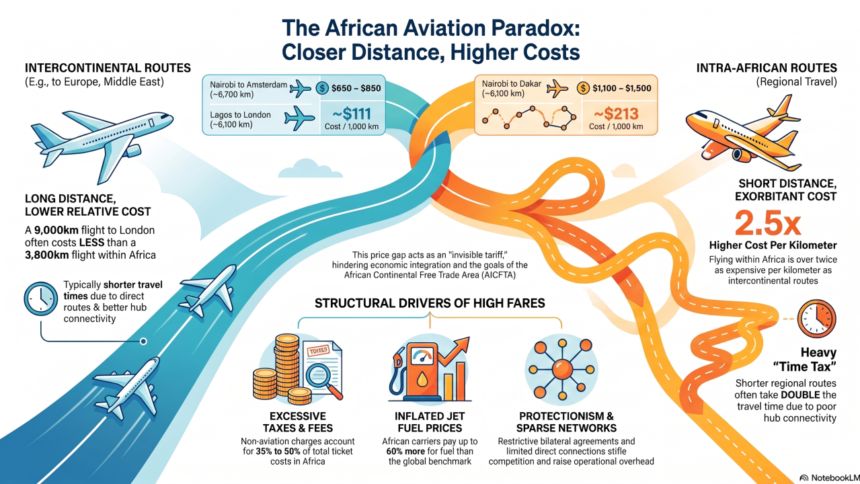
Nairobi to Lagos covers roughly 3,800 kilometers. Nairobi to London covers close to 6,800 kilometers, nearly double the distance.
On Kenya Airways’ own booking platform in July 2026, a round-trip economy fare to Lagos started at KES 122,300, close to $944 at prevailing exchange rates, for travel in August.
A round-trip economy fare to London for October travel started at KES 119,415, close to $922. The shorter route costs marginally more than the longer one. Fares of this kind move with season, demand and how far ahead a traveler books, so the comparison holds for that snapshot rather than as a fixed rule, but the direction is consistent with what African aviation bodies have spent years documenting.
The pattern is not uniform across every intra-African route. The same Kenya Airways platform listed a round-trip economy fare from Nairobi to Dakar, a longer route than Lagos at roughly 6,100 kilometers, starting at KES 106,095, close to $819, for February and March 2026 travel, cheaper than either the Lagos or London fares quoted above.
Route-level pricing depends on competition, frequency and demand on that specific city pair, which is why the continent-wide averages compiled by aviation bodies are a more reliable guide to the underlying cost structure than any single route comparison.
The African Airlines Association, in its 2024 Taxes and Charges Study Review, found that taxes, charges and fees make up more than 35 percent of the average air ticket price in Africa, and on some intra-African routes exceed 70 percent of the total cost. For a continent that adopted the African Continental Free Trade Area to eliminate barriers to commerce, the cost structure of its own airspace functions as a friction on the movement of people, goods and capital between African markets that the trade agreement does not touch.
AFRAA’s study puts the average taxes, charges and fees paid by a passenger on a regional African departure at $68. In Europe, the equivalent figure is $32. In the Middle East, it is $34. Africa’s regional traffic volumes are a fraction of both regions, meaning fewer passengers are absorbing a larger per-ticket government and airport charge. Western and Central Africa carry the highest regional charges on the continent, while Northern Africa carries the lowest, per AFRAA’s country-by-country breakdown.
Abderahmane Berthé, AFRAA’s Secretary General, has pointed to the Economic Community of West African States as one region moving to address the problem. In 2024, ECOWAS heads of state directed civil aviation and finance departments to reduce aviation taxes, and the bloc is set to abolish non-cost-related levies, including a long-standing security tax, and cut aviation charges by 25 percent from January 2026. Berthé has said the reform’s success will depend on whether airlines and regulators pass the savings on to travelers rather than absorbing them.
The taxes passengers see on their tickets are one part of the cost structure. The other sits with the airlines themselves.
IATA data published in July 2025 puts African carriers’ average cost per available tonne-kilometer at close to 140 US cents, nearly double the rest-of-world average.
IATA attributes the gap to both fuel and non-fuel costs, with fuel costs running 63 percent higher for African carriers and non-fuel costs, which include maintenance, insurance, ground handling and airport charges, running 112 percent higher.
Part of that non-fuel gap traces to fleet age. IATA data shows African carriers operating aircraft that are, on average, five years older than the global norm, which raises fuel burn and maintenance costs relative to newer fleets elsewhere.
Higher aircraft leasing rates and insurance premiums, reflecting perceived operating risk on the continent, add a further layer that does not show up on a passenger’s ticket but feeds into the fare an airline needs to charge to break even.
Restricted skies
Beyond taxes and operating costs, much of the continent’s airspace remains governed by bilateral air service agreements rather than open competition, with national carriers in a number of countries historically resistant to ceding lucrative regional routes to rivals.
The African Union’s answer has been the Single African Air Transport Market, or SAATM, launched to liberalize civil aviation across the continent. AFRAA reported 38 signatories to SAATM as of 2025, though implementation varies significantly by country, and the bilateral restrictions the initiative was meant to dismantle remain in force across large parts of the continent.
Berthe has argued that liberalization and expanding visa-free travel, alongside tax reform, are the two levers most likely to bring intra-African fares down and improve connectivity.
The AFRAA has also flagged that transfer fees, charged when a passenger connects through a second African airport, are becoming more common rather than less: 42 countries applied them in 2024, up from 35 in 2022, adding an average of $34.4 to the ticket price where they apply.
The freight dimension
Passenger routes and cargo capacity are linked in African aviation more tightly than in most regions, since a large share of the continent’s air freight travels in the belly of passenger aircraft rather than on dedicated freighters.
Fewer passenger flights on a given route, a direct consequence of high fares suppressing demand, mean less capacity available for cargo on that same route. For a free trade area built on the movement of goods as well as people, the shortage of affordable and frequent flights limits the capacity to move both.
Where it stands
AFRAA’s leadership has acknowledged industry concern over the tax burden while pointing to incremental progress, citing the ECOWAS reforms as the clearest recent example of governments acting on the issue. IATA’s Willie Walsh has separately urged African governments to cut aviation taxes even as the continent posted a 9 percent surge in passenger traffic in early 2025, arguing that high fees and restrictive bilateral policies are constraining an industry with room to grow.
Whether the ECOWAS reforms extend to other regional blocs, and whether SAATM’s signatories move from commitment to implementation, will determine whether the gap between the AfCFTA’s ambitions and the cost of physically connecting African markets narrows in the years ahead.