

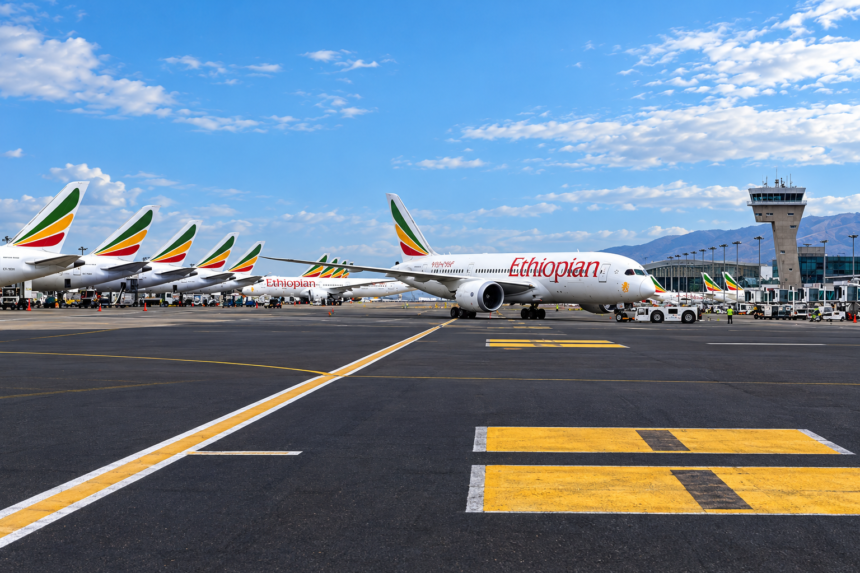
Ethiopian Airlines is expanding its cargo business with a new order for 10 Boeing freighter aircraft, in a deal that has a catalogue value of about $5 billion.
However, the $5 billion figure is not the amount Ethiopian Airlines has confirmed it will pay. Ethiopian Airlines CEO Mesfin Tasew and Boeing have kept the actual negotiated purchase price confidential.
The agreement, signed in Addis Ababa on September 30, 2026, covers eight Boeing 777-8 Freighters and two Boeing 777 Freighters, making Ethiopian Airlines the first African carrier to order Boeing’s next-generation 777-8F.
What is Ethiopian Airlines buying?
Of the 10 aircraft, eight are the new-generation Boeing 777-8F, while the remaining two are current-generation 777F freighters.
The two 777Fs are expected to be delivered in 2027 and 2028, while the eight 777-8Fs are scheduled for delivery between 2033 and 2035.
Ethiopian Airlines has also secured the right to purchase eight additional 777-8Fs. If the airline exercises those rights, its commitment to the new-generation freighter could rise to 16 aircraft.
The deal strengthens Ethiopian Airlines’ position in the global air-cargo market as the carrier continues to develop Addis Ababa as a major logistics and aviation hub connecting Africa with international markets.
The airline already operates a substantial dedicated cargo fleet, including 12 Boeing 777Fs, three Boeing 767 freighters and four converted Boeing 737 aircraft.
Its overall fleet has grown to more than 140 aircraft across passenger and cargo operations.
How unique is the 777-8F?
The 777-8F is designed for long-distance cargo operations, combining high payload capacity with improved operating efficiency. Boeing describes it as the next-generation addition to its large-freighter family.
The $5 billion figure represents the catalogue or list price of the 10 aircraft. It should not be interpreted as the final value of the contract.
Aircraft manufacturers commonly negotiate commercial discounts from published list prices, meaning the final transaction value can differ substantially from the catalogue figure.
The aircraft order comes as Ethiopian Airlines continues to invest heavily in its long-term aviation infrastructure and cargo network.
The airline is also involved in the development of a planned $12.5 billion airport project outside Addis Ababa, with the first phase targeted for completion in 2030.
The project is expected to provide additional capacity as Ethiopian Airlines expands its international operations.