

Sudan’s official gold exports earned $2.29 billion in the first nine months of 2026, the state-owned Sudanese Mineral Resources Company said. That puts the war-hit country’s main source of foreign currency on course for its best year since the company was founded.
Earnings for January to September are about 49% higher than the $1.536 billion recorded for all of 2025, according to central bank data, when 14.7 tonnes left through official channels.
Production reached 105% of the company’s plan for the period, the company said on Oct. 6. Revenue collection reached 131% of its target. The company didn’t disclose how many tonnes were exported.
State foreign currency from gold
Gold makes up more than 58% of Sudan’s export value, according to the Mineral Resources Company. Its share has grown since South Sudan’s secession in 2011 took most of the country’s oilfields. Since war broke out in April 2023, other exports have also fallen.
Most of the gold Sudan produces still doesn’t earn the state foreign currency. The country produced about 70.15 tonnes in 2025, the company said, but Finance Minister Gibril Ibrahim has said official exports that year didn’t exceed 20 tonnes. The rest left through informal channels or was processed locally. Each tonne brought into official channels adds to the foreign currency available to the central bank.
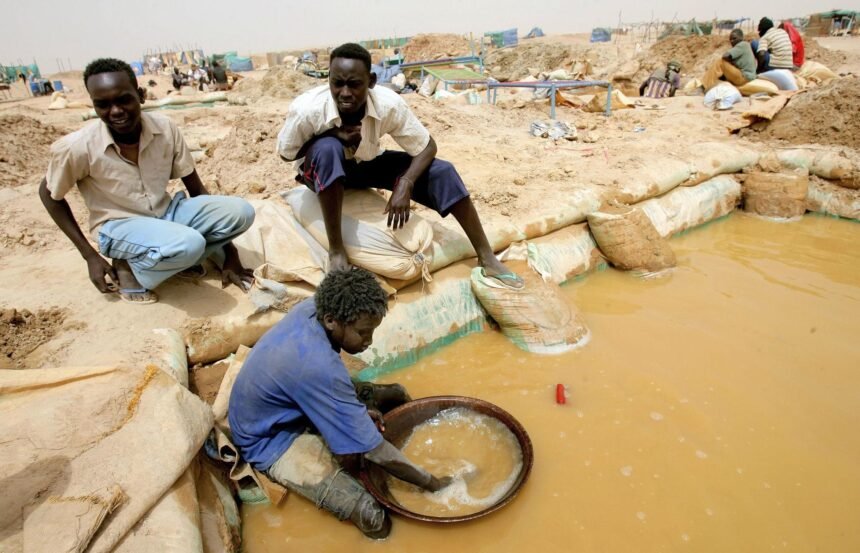
Artisanal miners produced about 58.38 tonnes of last year’s output, or roughly 83%, according to the company. Concession holders produced about 5.96 tonnes and companies reprocessing mine waste about 5.68 tonnes. Artisanal mining is concentrated in the River Nile, Northern and Red Sea states. Corporate output is growing too: 17 of the 61 mining companies in South Kordofan state have moved into production this year, the company said in July.
Supply from the border areas faces new risk. On Oct. 10, air strikes hit artisanal mining camps at Jabal al-Uqaydat in Red Sea State, near the Egyptian border, and more than 15,000 miners fled the site, according to survivors.
Death tolls range from 13, according to the Sudan Doctors Network, to more than 200, according to survivors. None of the counts has been independently verified. It was the second deadly strike at the site this year, after one in June.
Survivors accused Egypt’s military of the strikes. Egypt hasn’t said whether its aircraft were involved. On Oct. 12, its army said it was in the third phase of a campaign against illegal gold prospecting in its Eastern Desert, which began in June. Sudan’s army chief, Abdel Fattah al-Burhan, ordered a fact-finding committee the same day.
What to watch:
The Mineral Resources Company’s full-year figures, expected in January, will show whether the disruption in Red Sea State affects official exports and whether the company discloses export tonnage alongside earnings.