

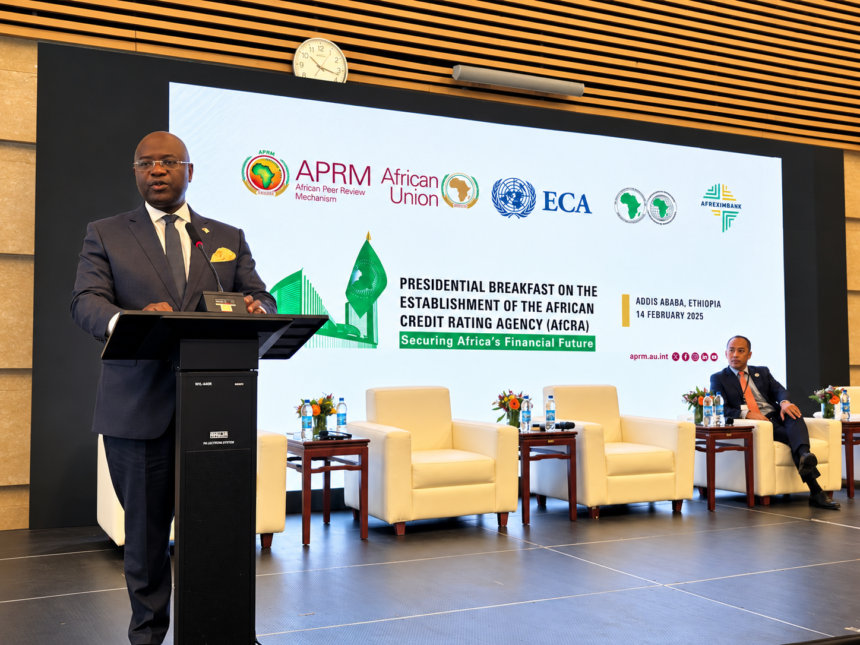
For decades, African governments have largely been the subjects of credit assessments rather than participants in shaping the architecture that determines how their risk is understood.
That is beginning to change.
The African Union (AU) has officially launched the Africa Credit Rating Agency (AfCRA) in Port Louis, Mauritius, creating a continental institution designed to provide an additional, independent assessment of the creditworthiness of African sovereigns, companies and institutions. The initiative has been years in the making, with the AU endorsing the idea in 2018.
But AfCRA is about more than creating another ratings agency. At its heart is a much bigger question: Has the global financial system been accurately pricing African risk?
“AfCRA complements existing global credit rating agencies by offering a perspective rooted in African data, expertise and realities,” the AU said.
The cost of being misunderstood
Credit ratings may sound technical, but their consequences are very real.
A country’s rating influences how investors price its bonds, how much it pays to borrow and, ultimately, how much money remains available for infrastructure, healthcare, education, energy and industrial development.
African policymakers have long argued that conventional sovereign-rating methodologies do not always capture the continent’s economic realities. They point to factors such as large informal economies, limited availability of reliable data, differences in economic structures and the difficulty of comparing African economies with developed markets using the same assumptions.
The argument is that when these realities are insufficiently reflected, investors may see more risk than actually exists.
The United Nations estimates that perceived inaccuracies and biases in sovereign credit assessments have cost African countries an estimated $74.5 billion annually in excess interest payments and foregone borrowing. The AU says Africa’s external debt-service burden has already risen dramatically, from $61 billion in 2010 to $163 billion in 2024.
That creates what has increasingly been described as an “Africa premium,” the additional cost attached to African borrowers because markets perceive them as riskier.
But there is an important distinction. It would be too simplistic to conclude that international rating agencies have simply been “wrong” about Africa.
The major agencies; Moody’s, S&P Global and Fitch, reject accusations of systematic anti-African bias and maintain that they apply their methodologies consistently across countries. A 2024 Reuters investigation also found no evidence of systemic bias in the sovereign ratings assigned to African countries by the major agencies.
The more interesting question, therefore, is whether a globally standardised methodology can fully capture locally specific risks and opportunities.
That is the gap AfCRA is attempting to address.
A different lens on African creditworthiness
The significance of AfCRA is that African economies will now have an institution whose mandate is to examine their creditworthiness through a deeper understanding of the continent’s economic environment.
The AU says AfCRA will use African data, expertise and economic realities to complement, rather than replace, existing international ratings. It will cover sovereigns, sub-sovereigns, corporates and other public and private institutions.
That distinction matters. The objective should not be to produce higher ratings simply because the agency is African. In fact, that could undermine the entire project.
If AfCRA gives an African government a lower rating because its fiscal position is weak, its debt trajectory is unsustainable or its institutions are inadequate, investors should be able to trust that assessment.
Its real value will come from answering a different question:
An African rating could, for example, place greater analytical weight on domestic capital markets, informal economic activity, regional trade, remittance flows, local-currency financing, commodity structures and country-specific institutional dynamics, factors that can be difficult to capture through conventional cross-country comparisons.
From Africa is risky to Which Africa?
This could fundamentally change the conversation between Africa and global capital.
For years, Africa has sometimes been treated as a broad risk category despite enormous differences between its economies. Kenya is not Ghana. Ghana is not Morocco. Morocco is not Nigeria. Nigeria is not Mauritius. And Mauritius is not South Africa.
Their debt structures, currencies, institutions, tax bases, export profiles, financial systems and political economies are fundamentally different.
Yet investors looking at Africa from outside the continent can still encounter a broad perception of elevated risk.
AfCRA has an opportunity to make that conversation more granular.
Instead of simply asking “How risky is Africa?”, investors can increasingly ask:
Which country? Which sector? Which borrower? Which currency? Which debt instrument? And what does the underlying data actually say?
That could be particularly important for Africa’s largely underdeveloped local-currency and corporate debt markets.
The AU estimates that only 32 of Africa’s 55 countries currently have ratings from the three major international agencies, leaving 23 without such ratings. Meanwhile, less than a quarter of the continent’s estimated $4 trillion capital base is covered by credit ratings.
That represents both a problem and an opportunity.
The investor may ultimately be the biggest beneficiary. The debate around AfCRA is often framed as an African governments-versus-Western rating agencies story.
Investors also need better information.
A pension fund, asset manager, bank or sovereign wealth fund deciding whether to invest in an African government or company needs credible information to distinguish genuine risk from poor information.
More credible ratings could therefore improve price discovery.
If AfCRA produces assessments that investors trust, African borrowers may eventually have more than one credible reference point when accessing capital markets.
That creates competition in the production of financial information — and competition can improve markets.
It could also encourage companies and governments that currently remain unrated to seek independent assessments, bringing more African issuers into the formal capital-market ecosystem.
But AfCRA has a credibility problem to solve
The agency’s biggest challenge may not be methodology. It will be trust.
Investors will inevitably ask whether an African institution can independently rate African governments, particularly politically influential ones.
That is why AfCRA’s independence will matter enormously.
The AU says governments will not own shares in the agency, while its governance framework is designed to protect its analytical independence and manage conflicts of interest.
But institutional safeguards on paper are only the beginning.
The real test will come when AfCRA gives an African government a rating that the government dislikes.
As rating experts have pointed out, credibility is built over time, particularly when an agency is willing to deliver uncomfortable conclusions during periods of economic stress.
If AfCRA consistently produces rigorous ratings, including downgrades where warranted, its credibility could grow rapidly.
If it becomes perceived as an institution created to give African borrowers favourable ratings, investors could simply ignore it.
Africa is not asking investors to lower their standards. This may be the most important point about AfCRA.
The continental agency cannot succeed by asking global investors to believe Africa more. It has to give them better reasons to understand Africa.
The AU itself has stressed that AfCRA is not intended to shield borrowers from scrutiny or guarantee favourable ratings. Its credibility will depend on independence, transparency, technical rigour and adherence to internationally recognised standards.
That is ultimately where the agency’s impact will be measured.
If AfCRA can demonstrate that African economies are sometimes being misunderstood, it will give investors a stronger analytical basis for reassessing those economies.
And if it confirms that certain countries genuinely carry elevated risk, that will also be valuable information.
Either outcome strengthens the market.
A new chapter in Africa’s relationship with capital
AfCRA therefore represents something bigger than the arrival of another rating agency.
It is an attempt by Africa to participate in defining the information through which its economies are priced by global capital.
For a continent facing rising debt-service costs, huge infrastructure financing requirements and an urgent need to mobilise private capital, that is strategically important.
The goal is not to make Africa look less risky. The goal is to make African risk more accurately understood.
If AfCRA succeeds, the long-term impact may not simply be higher credit ratings. It could be narrower spreads between perception and reality, deeper local capital markets, more informed investment decisions and, ultimately, a more differentiated view of African opportunity.