
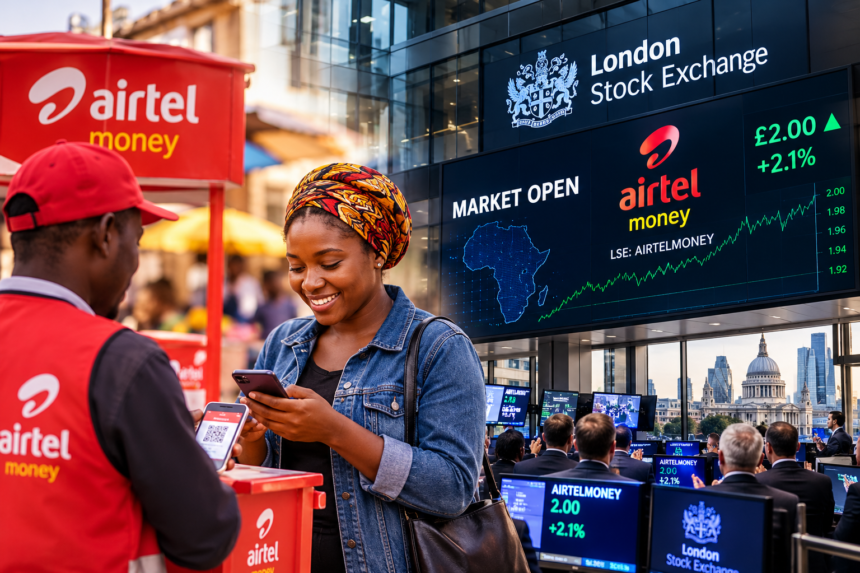
Airtel Money shares slipped below their £1.96 ($2.59) offer price on Friday after initially trading higher in London, as investors began weighing the valuation of one of Africa’s most closely watched fintech businesses.
The shares rose as much as 2.1% above the offer price before turning 0.6% ($1.55) lower by 9:30 a.m in London. The reversal came despite strong demand for the initial public offering (IPO), which attracted orders several times greater than the number of shares available.
The listing values Airtel Money at approximately $7 billion and gave international investors a direct opportunity to invest in a business whose growth is closely linked to the expansion of digital payments and financial inclusion across the continent.
Disclosed investors in the Airtel Money IPO?
The offer brings together international institutional capital and existing shareholders seeking to sell part of their investments.
- International Finance Corporation
The International Finance Corporation (IFC), a member of the World Bank Group, is the publicly disclosed cornerstone investor in the offering.
IFC committed £67.2 million, approximately $90 million, to purchase 34.29 million shares at the IPO price.
IFC’s participation is particularly relevant for African markets, where access to long-term investment capital remains important for scaling digital financial services. The investment gives the development finance institution direct exposure to Airtel Money’s growth while supporting the listing’s institutional investor base.
2. Qatar Investment Authority
The Qatar Investment Authority (QIA), Qatar’s sovereign wealth fund, is among the existing investors selling shares in the offering.
QIA held an approximately 8.07% stake in Airtel Money before the IPO, according to the company’s shareholder disclosures. Its participation reflects the role of sovereign wealth funds in financing African-focused businesses, although its IPO role should be understood as that of a selling shareholder rather than a confirmed cornerstone buyer.
3. Mastercard
Mastercard is another existing shareholder participating in the sale. Mastercard Asia/Pacific was also identified as the source of up to 27 million additional shares under the over-allotment option.
4. The Rise Fund: Private capital in Africa’s fintech story
The Rise Fund, backed by global investment firm TPG, is among the existing minority shareholders selling shares through the IPO.
Its involvement points to the role of private investment funds in backing financial technology businesses.
5. Chimetech Holding
Chimetech Holding is also among the shareholders associated with the offering. The Abu Dhabi-based entity is connected to the wider investment ecosystem around Chimera Investment and Lunate.
As with QIA and The Rise Fund, its role in the transaction should not be confused with that of a major new buyer. The public disclosures identify these investors among existing shareholders participating in the sale, but do not establish them as cornerstone purchasers comparable to IFC.
Numbers behind the listing
Airtel Money priced its shares at £1.96 each, implying a valuation of about £5.3 billion, equivalent to $7 billion.
The company offered 270 million existing shares, raising approximately £529.2 million, or $703 million, for the shareholders selling their stakes. A further 27 million shares could be sold through an over-allotment option, potentially increasing the total offer to approximately £582 million.
Importantly, this is a secondary share sale and proceeds will go to existing shareholders rather than directly to Airtel Money to finance its operations or expansion.
Parent company Airtel Africa is not selling shares in the base offer and is expected to remain a long-term strategic shareholder as the mobile money business moves into its next phase as an independently listed company.
Conditional trading on the London Stock Exchange began on October 9, with unconditional trading expected to start on October 14, subject to completion of the listing process.
The offering is one of London’s largest IPOs in recent years, arriving at a time when the exchange has been working to attract more companies and revive activity in its primary markets.
Where are the African institutions?
African banks are represented among the institutions managing the listing. Absa Bank and Standard Bank of South Africa are among the joint bookrunners, alongside international investment banks including Citigroup, Barclays, Goldman Sachs and JPMorgan.
Their role is to help manage and distribute the offering. It does not necessarily mean they are buying shares for their own investment portfolios.