
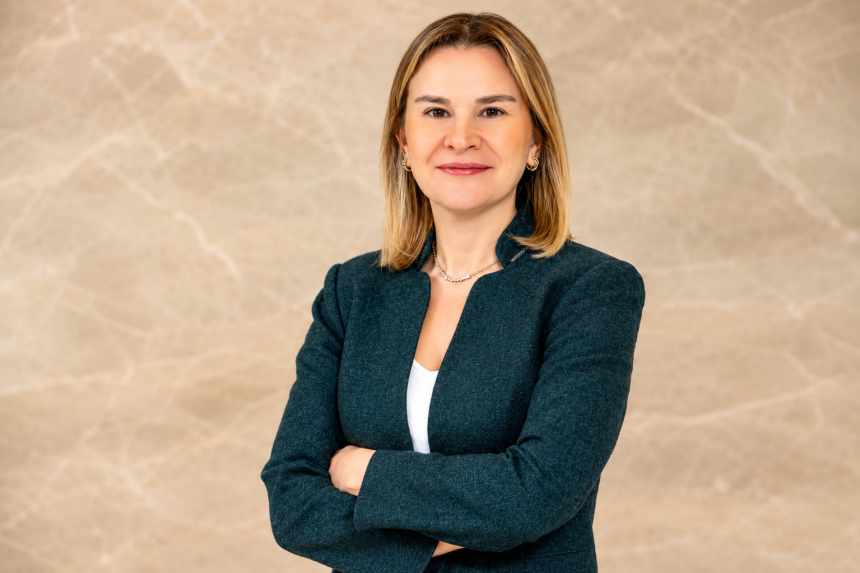
Dangote Petroleum Refinery has appointed Turkish finance executive Betül Sarıkaya as its new Chief Financial Officer (CFO), bringing more than 20 years of experience in energy finance, project financing, risk management and corporate governance to one of Africa’s largest industrial businesses.
Sarıkaya officially assumed the position on November 2, 2026, at a time when Nigerian billionaire Aliko Dangote is pursuing an expansion programme involving billions of dollars in investments across Africa.
Her appointment comes as the refinery moves into a new phase following its landmark initial public offering (IPO), which targeted approximately $1.63 billion, alongside plans to double its refining capacity and expand its regional energy distribution network.
Before joining Dangote, Sarıkaya served as CFO of the Turkic Investment Fund (TIF) and held senior positions at SOCAR Türkiye, including CFO of its Natural Gas Business Unit, Finance Director at STAR Refinery and Director of Internal Audit. She also previously worked as a Senior Manager at PwC and serves on the board of Aydem Renewables.
Her experience in managing large energy projects and financial structures comes at a critical time for Dangote as it prepares to finance and execute an increasingly complex investment pipeline.
IPO and $14.3 Billion Refinery Expansion
One of the group’s biggest capital-market developments is the IPO of Dangote Petroleum Refinery and Petrochemicals.
Launched on September 14, 2026, the share offering targeted $1.63 billion, making it one of Africa’s most significant industrial listings.
The company also secured a $1 billion underwriting programme ahead of the IPO, comprising a $600 million funded private placement and a further $400 million underwriting commitment.
The IPO is part of a plan to increase the refinery’s processing capacity from approximately 700,000 barrels per day to 1.4 million barrels per day through a $14.3 billion expansion programme targeted for completion by 2029.
The expansion is expected to strengthen Dangote’s position in the international petroleum market while increasing its capacity to supply African and overseas markets.
$50 Billion Investment Pipeline Across Africa
Beyond Nigeria, Dangote Group is targeting approximately $50 billion in capital expenditure between 2026 and 2030, with investments spanning energy, manufacturing, mining, ports and infrastructure.
Some of the major projects in the pipeline include:
- Kenya – $16 billion East African refinery: Dangote is developing a proposed 700,000-barrel-per-day refinery and petrochemical complex in Lamu, designed to serve Kenya and wider East African markets. The project is expected to create an industrial ecosystem around the facility.
- Ethiopia and Djibouti – $660 million pipeline: Dangote Group and Ethiopian Investment Holdings are developing a petroleum pipeline connecting Djibouti and Ethiopia, alongside storage infrastructure to improve fuel distribution.
- Southern Africa – $3.5 billion-plus pipeline network: The group is exploring a petroleum distribution network extending approximately 2,650 kilometres, linking Namibia, Botswana, South Africa, Zimbabwe and Zambia.
- Egypt – Potential $10 billion to $15 billion investment: Dangote has also explored opportunities in oil refining and petrochemicals in Egypt, although the proposed investments remain under discussion.
- Kenya Pipeline Company: Dangote has acquired a 24.76% stake in Kenya Pipeline Company, strengthening its position in East Africa’s petroleum transportation and distribution infrastructure.
These projects form part of Dangote’s ambition to build a $100 billion business by 2030 and expand African industrial capacity while reducing dependence on imported manufactured goods and petroleum products.
What Sarıkaya’s Appointment Means
Managing an investment programme of this scale requires more than access to capital. It demands careful management of project financing, debt obligations, foreign-exchange exposure, cash flows and investment returns.
Sarıkaya’s experience at STAR Refinery and SOCAR Türkiye gives her direct exposure to the financial demands of large energy businesses, while her background in internal audit and risk management could strengthen financial controls as Dangote expands its operations.
For investors, her appointment comes at an important moment. The group must demonstrate that its growing industrial footprint can translate into sustainable earnings, efficient capital allocation and long-term shareholder value.