
What to know
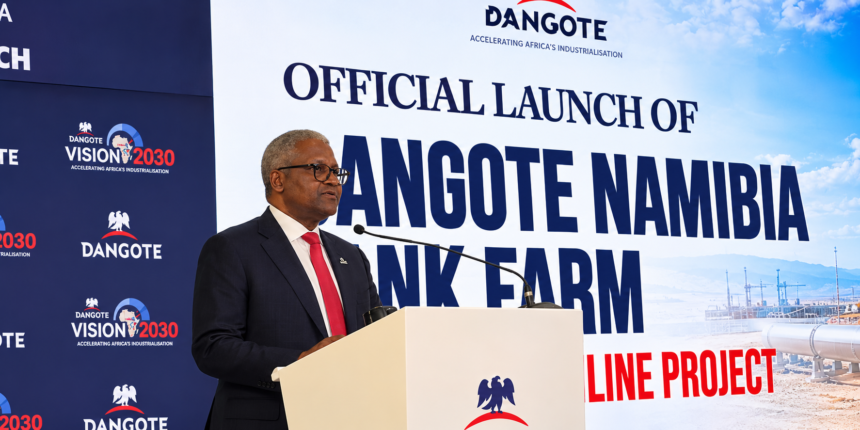
- Dangote Industries launched the Dangote Namibia Tank Farm and Regional Pipeline Project outside Walvis Bay on 4 November, with President Netumbo Nandi-Ndaitwah officiating.
- Aliko Dangote put the investment at $2.5 billion and said he expects completion within 18 to 20 months.
- The pipeline is planned to reach Botswana, Zambia, Zimbabwe, Malawi and parts of the Democratic Republic of Congo.
Dangote Industries has launched a $2.5 billion fuel storage and regional pipeline project at Walvis Bay, Namibia’s main port, with President Netumbo Nandi-Ndaitwah officiating at the ceremony on Wednesday.
Aliko Dangote, President and Chief Executive of Dangote Industries, said the investment would cover petroleum storage, pipeline infrastructure and distribution facilities. The terminal at Farm 58, outside the port town, is designed to hold 360 million litres of diesel and 240 million litres of petrol, according to Dangote. That is eight times the 75 million litres held at Namibia’s National Oil Storage Facility, which state-owned Namcor operates.
Dangote said the pipeline network, of about 1,700 kilometres, would connect Namibia to five inland markets. “We want to invest heavily so that landlocked countries can access petroleum products at cheaper prices,” he said.
The storage figure is more than double the 1.6 million barrels, about 254 million litres, described when the plans first surfaced in July 2025 and cited in Dangote Industries Namibia’s environmental filing in August this year. The pipeline is shorter than the network of roughly 2,500 to 2,650 kilometres Dangote outlined earlier.
Nandi-Ndaitwah said the project has been under the Office of the President since 2025 and would remain a presidential project until it is completed. Dangote said the group had raised its Africa investment target to 2030 from $50 billion to $60 billion.
The terminal would give Dangote’s 700,000 barrels-a-day refinery in Lekki, Nigeria, a distribution base on Southern Africa’s Atlantic coast.
What to watch
- The environmental impact assessment for the tank farm, which must be approved before construction of the petroleum facility begins.
- Pipeline agreements with transit and destination governments, and confirmation of whether the 1,700-kilometre network is a first phase.
- The 18 to 20 month completion target, which would bring the terminal into operation around mid-2028.