

Construction is set to begin this month on the Dangote Group’s Lamu refinery, a 700,000-barrel-a-day complex that would be East Africa’s largest when it starts up, with commissioning expected around 2029, according to the company and Kenyan officials. Dangote has said the September 30 groundbreaking will proceed even as the crude-supply question that will determine the refinery’s output remains open.
Four potential sources of crude are in play, each at a different stage of development.
Seaborne imports: the fastest option, and the one already tested
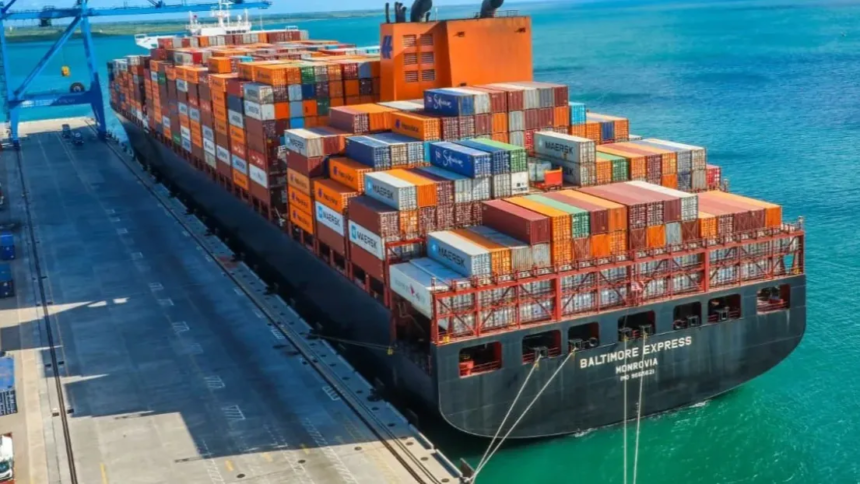
The most immediate route mirrors what Dangote already does at its refinery in Lagos: buy crude on term and spot contracts and ship it in. That refinery took roughly two years to reach its 650,000-barrel-a-day nameplate capacity, a delay the company has attributed to feedstock allocation and foreign-exchange constraints rather than technical problems. It crossed that threshold in February 2026 and tested above it, to 700,000 barrels a day, in June, according to Dangote Industries. By the first half of 2026, the refinery was operating at full capacity, the company’s initial public offering prospectus showed, reporting revenue of roughly 19.5 trillion naira ($13.9 billion) for the period.
Getting there required diversifying supply. Nigeria’s state oil company, NNPC, has a naira-denominated crude agreement with Dangote that was renewed for two years in 2025, but Dangote has said deliveries have fallen well short of what the deal envisioned at one point.
A company official told Nigerian media the refinery was receiving about four million barrels a month under the arrangement, versus roughly 13 million it expected. NNPC has disputed that characterisation, saying it supplied all naira-denominated cargoes it had available.
The refinery has filled the gap with cargoes from the U.S., Brazil, Angola, Equatorial Guinea, Algeria, Ghana, Libya and Guyana. S&P Global Commodity Insights estimated imports made up roughly a third of the refinery’s feedstock through 2025. In June 2026, the plant took its first Middle East crude — two cargoes from Abu Dhabi’s ADNOC according to traders cited by Reuters, marking its widest sourcing yet.
Two larger refiners illustrate what fully import-dependent operation looks like at scale.
Singapore, which produces no crude domestically, shifted purchases toward West Africa, Latin America and North America when the 2026 Iran-related shipping crisis disrupted Gulf supply routes. India’s Reliance Industries runs its 1.24 million-barrel-a-day Jamnagar complex, the world’s largest single-site refinery, on a blend of long-term contracts and spot cargoes from Russia, the Middle East, West Africa and the Americas.
By contrast, India’s Nayara Energy, a 400,000-barrel-a-day refiner tied almost exclusively to Russian crude under sanctioned ownership, shows the risk of the opposite approach: limited flexibility when a single source is disrupted.
Lamu’s version of this option is available immediately but constrained for now by the berth and storage infrastructure still under construction, according to project reporting. The closest precedents are Lagos and Jamnagar: build trading flexibility and storage capacity, and treat pipeline crude as upside rather than a starting assumption.
Domestic Turkana crude: real, but limited
Kenya’s own oil is the second option. Gulf Energy Ltd, which agreed in 2025 to buy Tullow Oil’s Kenyan assets for a minimum of $120 million, is targeting first oil from the Amosing and Ngamia fields in Turkana by December 2026, Energy Cabinet Secretary Opiyo Wandayi has said, with crude trucked to Mombasa rather than piped. The field development plan cleared the Energy Ministry in late 2025 and is awaiting parliamentary ratification. A proposed 825–895-kilometer pipeline linking Turkana to Lamu has no financing decision behind it.
The project’s history argues for caution: Tullow’s initial drilling campaign was halted by protests over local jobs and contracting in 2013, and Kenya’s national statistics office found in 2021 that roughly four in five Turkana households could not afford basic needs. Production is projected to start at about 20,000 barrels a day, rising to an estimated 50,000 to 120,000 barrels a day by the early 2030s, according to industry estimates.
South Sudan: the largest potential volume, tied to a decision Kenya doesn’t control
South Sudan represents the highest-volume option and the least certain one. Its crude currently exports through Sudan, a route repeatedly disrupted by that country’s civil war, including a pipeline rupture and force majeure declaration in 2026, in an economy that depends on oil for roughly 90% of state revenue, according to World Bank and industry data.
China National Petroleum Corp., the largest stakeholder in the Dar Petroleum operating consortium alongside Malaysia’s Petronas and China’s Sinopec, has held talks with Juba about building an alternative pipeline through Ethiopia to Djibouti rather than south through Kenya, according to South Sudanese government statements and industry reporting. No decision has been announced.
This is the option Lamu has the least ability to influence and, according to industry analysts, the one most likely to determine how the refinery ultimately performs.
Uganda: a route that was agreed upon, then abandoned
Kenya and Uganda signed an agreement in 2015 for a roughly 1,500-kilometre pipeline to Lamu, with about 850 kilometres running through Kenyan territory, before Uganda opted for a route through Tanzania instead in March 2016. That pipeline, the East African Crude Oil Pipeline, has reached about 92% completion, EACOP officials said in September, and is designed to carry roughly 246,000 barrels a day from Uganda’s Tilenga and Kingfisher fields to Tanzania’s Tanga port under 25-year offtake agreements.
Uganda’s own Hoima refinery, a planned 60,000-barrel-a-day domestic plant, has had its final investment decision pushed to early 2027 putting its own downstream ambitions behind Lamu’s rather than ahead of them. Current reporting shows no indication Uganda is reconsidering the Lamu route.
Ethiopia, Kenya, Rwanda: an equity stake rather than a crude source
The fourth option is not a supply route at all. Dangote has proposed a combined 30% equity stake in the Lamu refinery for Ethiopia, Kenya and Rwanda, a structure that would secure buyers rather than barrels, according to reporting on the offer.
Ethiopia’s position illustrates the appeal to Dangote. The country imports nearly all of its refined fuel, sources roughly half its gasoline and diesel from Gulf producers, and moves about 98% of its fuel imports through the Djibouti corridor, according to Ethiopian trade officials. That exposure became acute in early 2026, when fighting involving the U.S., Israel and Iran disrupted shipping through the Strait of Hormuz just as Addis Ababa was phasing out fuel subsidies under an IMF-backed programme. Official diesel prices reached 139.64 birr a liter in March 2026 and have risen further since, according to Ethiopia’s Ministry of Trade and Regional Integration.
Ethiopia’s own Ogaden Basin gas fields remain in a stalled rebidding process after regulators revoked Poly-GCL’s exploration licences in 2022, and a refinery under construction at Gode is designed for domestic consumption rather than export. An equity stake in Lamu would give the project a committed customer with a documented incentive to want reliable regional supply.
What to watch
Kenya’s ability to fill Lamu at scale rests, for now, on the seaborne-import route. Dangote has already proven workable in Lagos, according to industry analysts, a path that took roughly two years to reach full capacity there and carries similar import costs. Domestic Turkana output adds a real but modest volume later in the decade. Uganda’s crude is contractually committed elsewhere. The largest remaining variable is a pipeline routing decision between South Sudan and China National Petroleum Corp that has not been made public.