

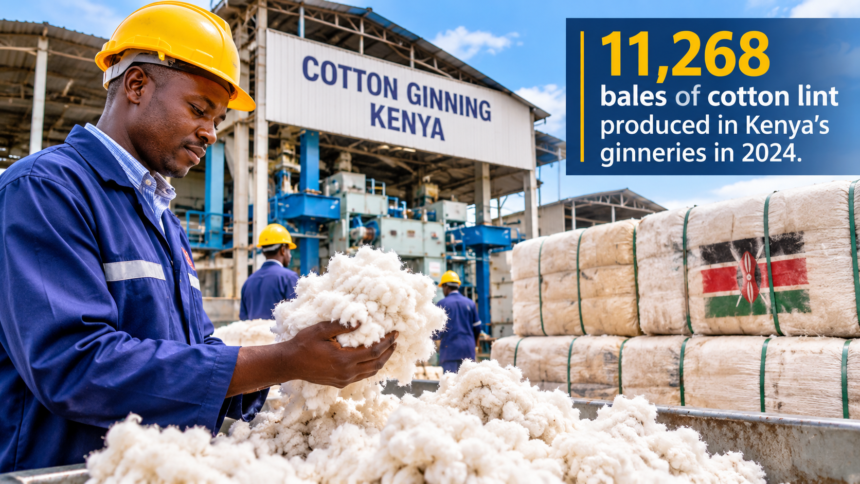
- Kenya’s ginneries produced 11,268 bales of cotton lint in 2024, up 61% in a year, according to the Agriculture and Food Authority (AFA).
- That covers less than a quarter of the 48,000 bales AFA estimates local mills need each year.
- The government is distributing Sh400 million (US$3.1 million) of pest-resistant Bt cotton seed in seven counties this season.
- Its budget targets 24,000 tonnes of seed cotton by 2027/28, almost four times the 2024 harvest.
Kenya has an unusual cotton problem. Its garment factories already sell clothes to America by the container load. Apparel exports under the African Growth and Opportunity Act (AGOA) reached Sh60.6 billion (US$470 million) in 2024, according to the Kenya National Bureau of Statistics, and the industry supports more than 66,000 direct jobs. Very few of those clothes are made from Kenyan cotton. The country grows too little of it, spins even less, and its exporters have no trade incentive to buy local.
The farms are recovering. AFA’s 2025 Statistical Yearbook shows seed cotton production rising from 3,863 tonnes in 2023 to 6,234 tonnes in 2024. Seed cotton is the crop as it comes off the plant, before the fibre is separated from the seed. Kenya’s seven working ginneries turned that harvest into 11,268 bales of lint, the clean fibre that spinning mills use, up from 7,006 bales a year earlier. The value of that lint rose from Sh310 million (US$2.4 million) to Sh527 million (US$4.1 million). Planting has kept climbing since. The Ministry of Agriculture’s latest budget records 46,564 acres under cotton in 2025/26, about 18,800 hectares, against 16,469 hectares in 2024 and a target of 34,762 acres.
Demand is far larger. AFA estimates that Kenyan mills need about 48,000 bales of lint a year, so local farms supplied less than a quarter of it in 2024. Manufacturers import the rest, mostly from Tanzania and Uganda. Every imported bale is income earned by a farmer across the border rather than one in Busia, Kitui or Lamu.
The government’s answer is seed. This season it is distributing Sh400 million (US$3.1 million) of Bt cotton seed with Thika Cloth Mills to farmers in Embu, Tharaka Nithi, Meru, Kirinyaga, Machakos, Makueni and Kitui. Bt cotton is bred to resist the African bollworm, a pest that can destroy a large share of a crop. The State Department for Industry says traditional seed yields 250 to 300 kilograms of seed cotton per acre and Bt cotton about 500 kilograms. A farmer who switches can roughly double the harvest from the same field. The constraint is supply. The Kenya Agricultural and Livestock Research Organization (KALRO), which is building the country’s first certified cotton seed system at Kibos and Mwea, produced 3.8 tonnes of basic seed in 2025/26 against a target of 5.5 tonnes. Basic seed is the foundation stock that is multiplied into the seed farmers plant, so a shortfall now limits how many farmers can switch in later seasons.
The targets are demanding. The Ministry of Agriculture’s budget aims for 24,000 tonnes of seed cotton from 40,000 acres by 2027/28. That works out at 600 kilograms an acre, more than the 500 kilograms the government itself attributes to Bt seed. The National Treasury’s 2026 Budget Policy Statement adds plans to produce 22.6 tonnes of cotton seed, build value-addition facilities for cotton cooperatives and expand spinning, weaving and garment capacity through textile parks and public-private partnerships. The ambition has narrowed since January 2025, when the State Department for Industry set a goal of 340,000 acres within three years. The current budget target is less than an eighth of that.
Private capital is moving faster than the harvest. Thika Cloth Mills has built a Sh1.2 billion (US$9.3 million) ginnery at Mpeketoni in Lamu, designed to process up to 20 million kilograms of cotton a year through contract farming with local cooperatives. Lamu farmers sold about 3.5 million kilograms in 2025, worth about Sh335 million (US$2.6 million), enough to run the ginnery at less than a fifth of its capacity. A new ginnery is also operating at Mulwanda in Busia, and the government has committed Sh5 billion (US$39 million) to revamp Rivatex, the state-owned mill in Eldoret.
The weakest link sits between the ginnery and the garment factory. The government’s draft Cotton, Textile and Apparel Policy counts 52 textile mills in Kenya, of which 15 operate, at about 45% of capacity. Power is a large part of the reason. A regulatory audit published by the Kenya Association of Manufacturers in April 2026 put Kenya’s industrial electricity tariffs at 18 to 23 US cents per kilowatt-hour, against about 8 cents in Tanzania, 5 cents in Ethiopia and 3 cents in Egypt. Spinning and weaving run around the clock, and a Kenyan mill can pay four times as much for power as an Ethiopian one.
Trade rules add to the pressure. AGOA’s third-country fabric provision allows Kenyan garment exporters to use fabric from anywhere in the world and still enter the American market duty-free. Their fabric comes overwhelmingly from Asia, where it is cheaper. Kenyan yarn and cloth must compete on price and reliability, with no rules-of-origin advantage to help them. The renewal of AGOA through December 2028, signed by President Donald Trump on 4 September 2026, gives investors two more years of certainty. Afreximbank said in March 2026 that it is in talks with Kenya over financing for the textile sector.
Kenya already has the end of the chain, in export garment factories with secure access to the American market, and it is rebuilding the start, in seed, farms and ginneries. The spinning and weaving that would turn Kenyan fibre into the fabric those factories sew remain the missing middle, and the revival’s success depends on them.
- Kenya’s 2024 cotton harvest rose 61%, but local farms still met less than a quarter of mill demand.
- Bt seed can roughly double yields, but KALRO produced 3.8 tonnes of basic seed against a 5.5-tonne target.
- The 2027/28 target of 24,000 tonnes from 40,000 acres needs yields above what Bt seed currently delivers.
- Only 15 of Kenya’s 52 textile mills are running, and industrial power costs up to four times as much as in Ethiopia.
- AGOA access through 2028 and Afreximbank’s interest give the sector a window to build the missing middle of the chain.