

A Kenyan earning KSh50,000 a month could soon see an additional KSh2,083 in their payslip if the National Treasury’s proposed PAYE changes are approved by Parliament.
The proposal, expected to be tabled in the National Assembly next week, would make the first KSh32,333 of monthly earnings tax-free. It would remove the existing 10 per cent and 25 per cent tax bands on that portion of income and scrap the KSh2,400 monthly personal relief.
For workers earning above KSh32,333, the remaining taxable income would continue to attract graduated rates of 30 per cent, 32.5 per cent and 35 per cent.
The Treasury’s proposal would therefore change how PAYE appears on the payslip, rather than eliminate statutory deductions altogether.
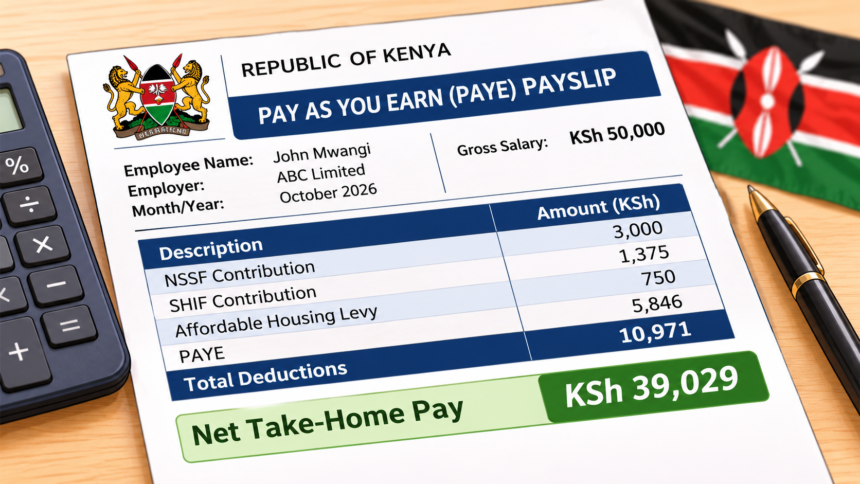
For a worker earning KSh50,000, the estimated monthly breakdown under the current system is:
- Gross salary: KSh50,000
- NSSF: KSh3,000
- SHIF: KSh1,375
- Affordable Housing Levy: KSh750
- PAYE: approximately KSh5,846
- Current take-home pay: approximately KSh39,029
Under the proposed tax arrangement, NSSF, SHIF and the Housing Levy would remain payable. However, PAYE would fall to approximately KSh3,763, lifting estimated net pay to KSh41,112.
That is an increase of about KSh2,083 a month, or KSh24,999 over a full year.
The change would also be visible on the payslip. The PAYE line would shrink, while the other statutory deductions would remain. The precise presentation will depend on the final legislation and payroll implementation.
How does KSh50,000 compare with the pre-2022 election payslip?
The bigger question is what the proposed relief means when compared with what the same worker took home before the August 2022 General Election.
Using the tax bands and statutory deductions applicable in 2022, a resident employee earning KSh50,000 gross would have had an estimated take-home pay of about KSh41,177.
That estimate assumes the former NSSF contribution of KSh200, NHIF contribution of KSh1,300 for the relevant salary bracket, the then PAYE bands and KSh2,400 personal relief. It excludes other voluntary deductions and individual tax reliefs.
Under the proposed 2026 arrangement, the same gross salary would produce an estimated KSh41,112 in net pay.
In other words, the proposed changes would bring the worker almost back to the take-home amount they received in 2022, a difference of roughly KSh65 a month.
| KSh50,000 gross salary | Estimated monthly take-home |
|---|---|
| Before the August 2022 election | KSh41,177 |
| Current 2026 deductions | KSh39,029 |
| Under proposed PAYE changes | KSh41,112 |
The comparison is revealing. The proposed relief would largely restore the nominal take-home pay of four years ago, but it would not restore the purchasing power that salary once carried.
The figures are estimates, not a comparison of identical payslip deductions: the 2022 system had NHIF and the old NSSF contribution structure, while the current system includes SHIF, the Affordable Housing Levy and higher NSSF contributions.
What can KSh2,083 actually buy?
For a household already struggling with food and transport bills, an additional KSh2,083 is useful. But its value depends on how far it stretches.
Consider milk. A consumer who was buying a packet for KSh65 two months ago and now finds it selling at KSh100 is paying KSh35 more per packet, a price increase of about 54 per cent.
At that rate, the additional KSh2,083 could cover the price difference on approximately 59 packets over a month. But that is only a comparison of the increase in price, not the cost of buying the milk itself. A family buying one packet every day would spend an extra KSh1,050 a month compared with the earlier price, leaving only about KSh1,033 of the tax relief for other expenses.
The cost of getting to work is another concern.
Kenya’s exposure to international oil prices has become more visible as the US-Israel war with Iran disrupts energy markets and raises the cost of fuel imports. In Nairobi, EPRA’s October 15 to November 14 price review set petrol at KSh226.96 per litre and diesel at KSh227.76. Petrol rose by about 6 per cent, while diesel increased by 4.5 per cent.
Diesel is particularly important because it powers a large share of public transport and goods movement. Higher costs can feed into matatu fares, delivery charges and the prices consumers pay for food and other essentials.
A worker who spends more on commuting and groceries could therefore see much of the KSh2,083 absorbed before the month is over.
A welcome tax adjustment, but not a full cost-of-living solution
The Treasury expects the changes to reduce payroll tax collections by about KSh3.7 billion every month. Its argument is that putting more money in workers’ hands could support household consumption and stimulate economic activity.
For employees, the benefit is straightforward: less PAYE and more disposable income. For businesses, stronger household spending could support demand for goods and services.
But the proposal should be viewed in context. It does not lower the price of fuel, reverse food inflation or reduce the cost of public transport. Nor does it remove the other statutory deductions that continue to come off employees’ salaries.
The KSh2,083 increase would offer some breathing room, particularly to households living close to their monthly budgets. Yet the comparison with 2022 shows the limits of the relief: a worker earning KSh50,000 could soon take home almost what they did four years ago, while facing a very different cost of living.
The proposed changes still require parliamentary approval before employers can apply them. Until the Bill is passed and the implementation details are confirmed, the higher take-home pay remains a proposal rather than a change workers should expect on their next payslip