

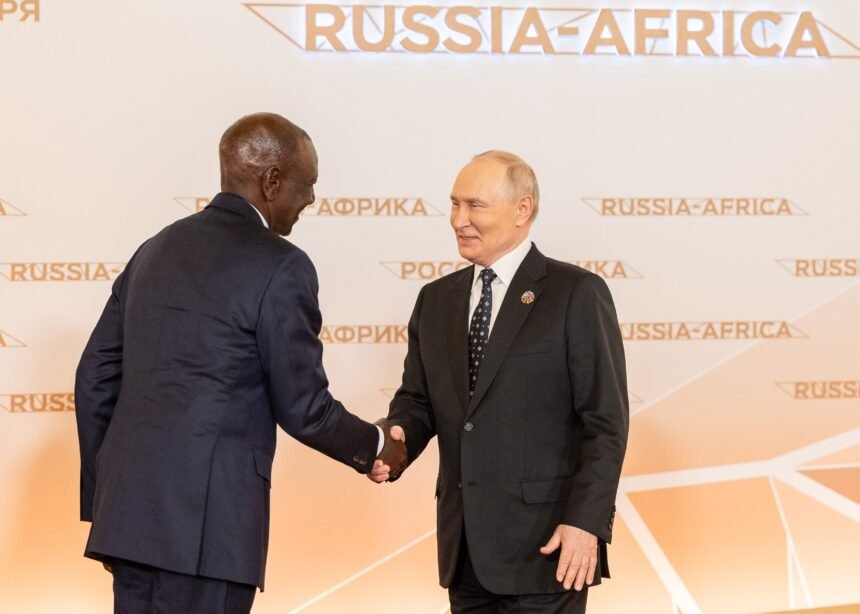
Russia is targeting more than $50 billion in trade with Africa as President Vladimir Putin seeks to deepen economic ties with the continent, while African leaders are pressing Moscow to invest in local industries, create jobs and transfer technology rather than simply sell finished products.
The push featured prominently at the third Russia-Africa Summit in Moscow, which brought together delegations from 48 African countries, including 22 heads of state. About 4,000 Russian and African entrepreneurs were invited to more than 40 business events held alongside the summit.
Putin said Russia’s trade with Africa exceeded $27 billion in 2025, up from $18 billion in 2022. He wants to more than double the figure to over $50 billion.
Moscow is offering cooperation in agriculture, fertiliser, machinery, technology, cybersecurity and water management. It has also proposed alternative payment arrangements using national currencies and existing pan-African payment systems to reduce reliance on Western financial networks.
Russian fertiliser producer PhosAgro delivered more than 1.3 million tonnes of fertiliser to Africa in the first nine months of 2026, exceeding its total shipments to the continent for all of 2025.
Putin acknowledged, however, that African agricultural products still account for a relatively small share of Russia’s imports. African farm imports reached about $4 billion this year, representing 8% of Russia’s import needs.
“But 8% is not that much,” Putin said, adding that the figure must and will grow.
Ruto Pushes for Russian Investment in Kenya
Kenya is seeking to turn stronger trade relations with Russia into investments that build domestic manufacturing capacity and create employment.
Speaking at a Russia-Kenya business roundtable in Moscow, President William Ruto urged Russian companies to establish factories and invest in industries that can serve Kenya and wider African markets.
“For too long, Africa’s engagement with the global economy has been defined by the export of raw materials and the importation of manufactured goods, with much of the value, industry and employment created elsewhere,” Ruto said.
“This model has constrained Africa’s industrial development and denied our people the full economic benefits of their resources. It is neither sustainable nor acceptable.”
Ruto called for investment in manufacturing, mineral processing, agriculture, energy, transport and engineering, arguing that partnerships should generate tangible economic benefits rather than stop at trade agreements.
“Invest in Kenya, manufacture in Kenya, and serve Africa and the world from Kenya,” he told Russian investors.
Bilateral trade between Kenya and Russia stands at approximately $380 million, while Russian investment in Kenya is estimated at $22 million. Kenya mainly exports tea, coffee, flowers, fruits and vegetables to Russia, while imports include wheat, fertilisers, iron and steel products.
Ruto said the relationship should be measured by “projects implemented, industries established and jobs created.” He also pointed to Kenya’s access to the African Continental Free Trade Area, which offers investors an opportunity to serve a continental market of approximately 1.5 billion people.
Africa Wants More Value From Its Resources
African leaders used the summit to press for partnerships that support industrialisation and domestic processing.
African Union chair and Burundi President Evariste Ndayishimiye said the continent wanted to process its natural resources at home instead of remaining primarily a supplier of raw materials. Namibia’s delegation similarly sought investment, technology transfer and local mineral processing.
However, Russia’s latest trade ambition comes with a history of targets that have proved difficult to meet. At the inaugural Russia-Africa Summit in 2019, Moscow pledged to increase trade to $40 billion within five years, but volumes stalled at around $18 billion.
The 2023 summit generated 92 agreements and memorandums with disclosed values exceeding $12.5 billion, although signed commitments did not necessarily translate into completed investments.
The latest summit was expected to produce 33 intergovernmental, interagency and commercial documents, alongside an action plan covering 2027–2029.
For African businesses considering Russian partnerships, the critical questions will be whether financing is available, how transactions will be settled and how much production, technology and employment will remain on the continent.