

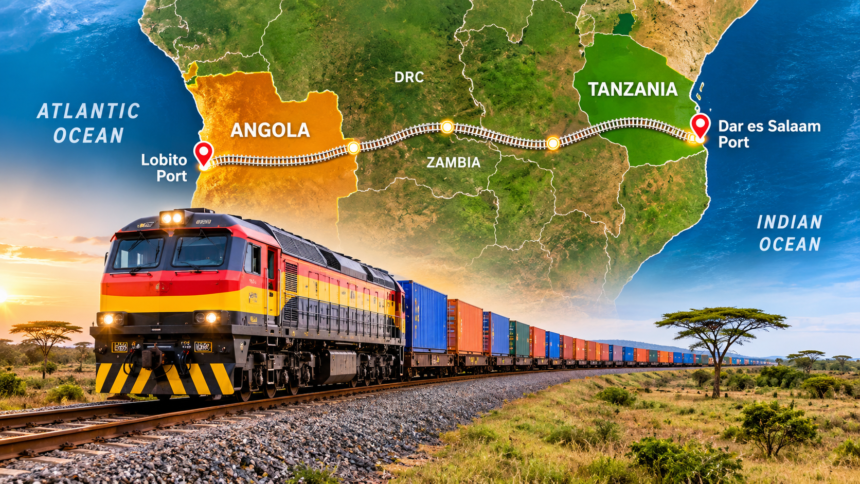
Tanzania and Angola are pursuing a railway connection that could create a continuous trade route between Africa’s Atlantic and Indian Ocean coasts, opening new transport opportunities for landlocked economies and mineral exporters across Central and Southern Africa.
The proposed railway would connect Angola’s Benguela Railway to the Tanzania-Zambia Railway Authority (TAZARA) network, extending the route to the port of Dar es Salaam. The connection would run through Zambia and the Democratic Republic of Congo (DRC), linking Angola’s Lobito Corridor on the Atlantic coast with Tanzania’s Central Corridor on the Indian Ocean.
Tanzanian President Samia Suluhu Hassan announced the agreement, describing the initiative as part of efforts to strengthen regional transport infrastructure and facilitate cross-border trade.
If realised, the project would give exporters in Zambia and the DRC access to ports on two different oceans, potentially improving their ability to move minerals and other commodities to international markets.
A New Dimension to Africa’s Railway Competition
The proposed connection comes as international investors and governments increase their involvement in developing strategic railway corridors across Africa.
In 2025, China signed a $1.4 billion agreement with Tanzania and Zambia to modernise the TAZARA railway, which was originally financed by Beijing in the 1970s to facilitate copper exports and fuel imports.
The railway connects Dar es Salaam with Kapiri Mposhi in Zambia and has historically served as an important trade route for landlocked mineral-producing economies.
On the Atlantic side, the US and European Union have backed the development of the Lobito Corridor, which connects Angola’s port of Lobito to mineral-rich areas of Zambia and the DRC.
Italian construction company Webuild has also won a tender to construct a section of the Zambia-Lobito Railway Corridor, adding momentum to the development of the Atlantic-facing transport network.
Connecting the two systems would create a broader railway network across the continent, giving exporters more flexibility in choosing shipping routes and potentially reducing dependence on individual ports and transport corridors.
What the Railway Could Mean for Regional Trade
The proposed railway could be particularly significant for Zambia and the DRC.
Both countries are important producers of copper and other minerals used in electricity infrastructure, renewable energy technologies and industrial manufacturing.
Improved railway connectivity could make it easier to transport these commodities to international markets while potentially reducing the cost and time associated with moving goods over long distances by road.
For Tanzania, the connection could strengthen Dar es Salaam’s position as a major regional logistics and trade gateway, attracting additional cargo from Central and Southern Africa.
Angola, meanwhile, would gain stronger links to East African markets, creating opportunities to expand exports beyond its traditional oil sector.
However, the proposal remains at the agreement stage. Financing arrangements, construction timelines and the infrastructure required to connect the existing railway networks have yet to be fully outlined.
Tanzania and Angola Explore Energy Investment
Angola has invited Tanzania to participate in its proposed Lobito oil refinery project, with the Tanzania Petroleum Development Corporation (TPDC) assessing the viability of a potential investment.
The discussions come as East African countries seek to strengthen their petroleum supply chains and expand domestic refining capacity.
Tanzania is also considering its participation in other regional refinery projects. Kenya and Rwanda have committed to acquiring stakes in the refinery being developed by Nigerian billionaire Aliko Dangote, while Tanzania and Uganda are discussing plans for a separate refinery in Tanga.
The proposed railway connection and energy discussions point to a shift towards regional infrastructure partnerships, with African governments increasingly looking beyond national borders to develop trade, transport and industrial capacity.